Humans
 PUBLISHED

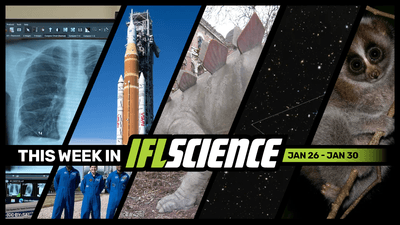


This week, two giant forelimbs may be evidence of the largest stegosaurid ever found, the most distant galaxy ever found existed 280 million years after the Big Bang, and there’s just one known venomous primate in the world, but it’s deceptively adorable. Finally, we question why it is humans are so invested in watching fire.
Create an IFLScience account to get all the biggest science news delivered straight to your inbox every Wednesday and Saturday.
Transplant Patient Survives For An Incredible 48 Hours Without Lungs While Preparing For Surgery
Artificial "lungs" kept a patient alive for two days without real ones after their diseased lungs were removed so they could become healthy enough to receive a double lung transplant. When the donor lungs were provided, analysis of the old ones showed that the approach was necessary, indicating that more patients would benefit from such a lungless interval. Read the full story here
How Big Is Artemis II's Orion Capsule? Smaller Than You Might Think
Forget the spacious interior of Starship Enterprise, the multi-deck structure of the Rocinante, or even the more cozy corridors of the Millennium Falcon. Humans’ return to the Moon is a compact affair. The Orion capsule is small and functional, and hopefully, next week, it will take four astronauts on a 10-day journey to the Moon for the first time in over 50 years. So what does a spacecraft that operates as bedroom, kitchen, dining room, bathroom, and workplace, all of which you have to share with three other people, look like? Read the full story here
This May Be The Largest Stegosaurid Ever Found – And It's Far Bigger Than We Thought Possible
Two giant forelimbs have been found from a Stegosaurus, or related species, that are longer than any discovered before. Indeed, the bones are 38 percent longer than the average adult stegosaurid's, suggesting these armored dinosaurs grew to almost sauropod size. Astonishingly, these important finds were made 76 years ago, but palaeontologists have only now realized what they have. Read the full story here
"Cosmic Miracle" Confirmed: Most Distant Galaxy Ever Seen Existed 280 Million Years After The Big Bang
We are seeing farther back into the universe than ever before. JWST has been able to peer at galaxies located at incredible distances. The most distant yet was announced last year, and now it has been confirmed. MoM-z14 is currently the most distant galaxy known, existing just 280 million years after the Big Bang. Read the full story here
There's Only One Known Venomous Primate In The World, And It's One You Least Suspect
Primates – ourselves included – usually rely on a blend of brains and brawn to get things done. However, there is one notable exception that brings toxins to the table, and it's surprisingly cute. The slow loris is the only known primate that is venomous, placing it in an elite club of venomous mammals alongside the platypus, certain shrews, the European mole, and a handful of others. Read the full story here
TWIS is published weekly on our Linkedin page, join us there for even more content.
Feature of the week:
Why Do Humans Love Watching Fire?
There are few greater joys than standing around a campfire, gazing at its colors and shapes, feeling its warmth on your body, hearing its crackles and roars, and smelling the oddly comforting odor of smoke. At a glance, our love of flames seems obvious: fire = warmth and, hopefully, food. However, if you dig deeper, you’ll discover that this connection goes far beyond simply satisfying our basic animal instincts. Read the full story here
More content:
Have you seen our e-magazine, CURIOUS? Issue 42, January 2026, is available now. This month, we asked, “Why Do We Cry?” – check it out for exclusive interviews, book excerpts, long reads, and more.
PLUS, the We Have Questions podcast – an audio version of our coveted CURIOUS e-magazine column – continues. In episode 17, we ask, “How Can Swimming For 37 Hours Help Tackle Ocean Plastic?”
The Big Questions podcast season 5 has now concluded, but here’s one more bonus episode to help see you into 2026: Can Magic Be Used As A Tool In Science? You can catch up on the whole of season 5 here.