Health and Medicine
 PUBLISHED
 1
1


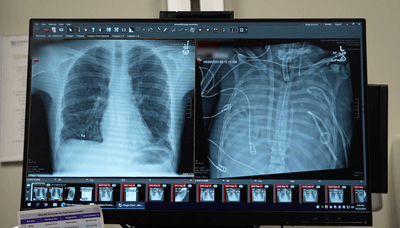


A patient has survived for two days on externally oxygenated blood in the gap between their diseased lungs being removed and becoming healthy enough to receive a transplant. When the donor lungs were provided, analysis of the old ones showed that the approach was necessary, indicating that more patients would benefit from such a lungless interval.
The development of lungs to mix oxygen from the air with the bloodstream was one of the key developments necessary for vertebrates to live on land. For the subsequent 400 million years, every amphibian, reptile, bird, and mammal has relied on them, at least until very recently.
A previously healthy 33-year-old male represents a warning to anyone who thinks influenza B is only a serious threat to the old or the very young. He came to hospital with acute respiratory distress syndrome (ARDS), and over the next six weeks, a Pseudomonas aeruginosa secondary infection caused him to develop necrotizing pneumonia. Neither antibiotics nor oxygen therapy could reverse or even halt his decline, causing his heart and kidneys to start failing.
“His heart stopped as soon as he arrived. We had to perform CPR,” Professor Ankit Bharat of Northwestern University, who led the campaign to save the patient, said in a statement. “When the infection is so severe that the lungs are melting, they’re irrecoverably damaged. That’s when patients die.”
Even if a double lung transplant became available, the patient’s body was too damaged from the infection to accept it. Only by removing the lungs could the infection be brought under control, creating the possibility that the other organs would start to heal, but that came with an obvious problem: “The heart and lungs are intrinsically connected,” Bharat said. “When there are no lungs, how do you keep the patient alive?”
Until recently, you couldn’t, but some patients with cystic fibrosis whose lungs have almost entirely failed have lived for days on the oxygen provided by artificial lungs. Bharat’s team created a machine capable of replicating the lungs’ role in adding oxygen to the blood and taking out carbon dioxide while maintaining the rate of flow through the weakened heart.
 and Dr. Ankit Bharat (right) operating on a patient, removing the damaged lungs and attaching an artificial lung. Credit. Northwestern Medicine.png "Dr. Chitaru Kurihara (left) and Dr. Ankit Bharat (right) operating on a patient, removing the damaged lungs and attaching an artificial lung, prior to the transplant two days later.")
The interim system did not need to be created out of thin air. Artificial lungs that can provide assistance to biological ones that are struggling already exist. Bharat and colleagues describe the oxygenation of the blood through a membrane as “conventional,” but the steps to prevent excessive pressure in the heart, arteries, and ventricles were more innovative. The team relied on providing alternative pathways for blood to get into and out of the heart using a shunt that constantly adapted to the strength of flow.
As soon as his lungs were removed and the externally oxygenated blood supplied, the patient’s other organs started to get better. Two days later, when donor lungs became available, surgeons judged him in a state to receive them, and the transplant was performed.
A paper on the operation has only been published now, after the patient has survived with good lung function for the following two years, returning to a healthy routine (and probably diligently getting flu vaccinations).
“Conventionally, lung transplant is reserved for patients who have chronic conditions like interstitial lung disease or cystic fibrosis,” said Bharat. “Currently, people think if you get severe ARDS, you keep supporting them and ultimately the lungs will get better.”
That didn’t seem likely before the operation, and examination and analysis of the patient’s lungs after removal showed it would not have happened. The scarring was so widespread and extreme that the tissue would not have recovered.
“For the first time, biologically, we are giving molecular proof that some patients will need a double lung transplant, otherwise they will not survive,” Bharat said.
Few hospitals would currently be able to perform an operation like this. Nevertheless, Bharat hopes that as the operation is repeated it will be refined, so that patients can be kept alive longer when no donor lungs are immediately available. However, with donor lungs already available for only a fraction of those who need them, the ultimate goal is to create something more lasting.
“In my practice, young patients die almost every week because no one realized that transplantation was an option,” Bharat said. “For severe lung damage caused by respiratory viruses or infections, even in acute settings, a lung transplant can be lifesaving.”
The study is published in Med.