Nature
 PUBLISHED
 1
1


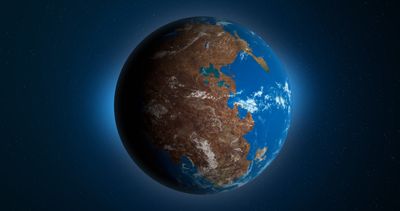


Earth’s continents appear to be in a constant cycle of breaking apart and moving together. At this moment in time, we're in an awkward intermediate phase following the breakup of Pangea around 175 million years ago. If that’s accurate, it’s looking like Earth could be sliding back into a supercontinent another 250 million years down the line.
The surface of Earth might seem solid and unchanging, but it’s actually in slow, restless motion. The continents are like giant puzzle pieces sitting on top of massive tectonic plates, drifting across the globe over millions of years. These plates shift, collide, and pull apart, breaking up old supercontinents and giving rise to new ones in a grand, slow-motion cycle.
Over the past two billion years, this supercontinent cycle has produced at least three major supercontinents: Columbia, Rodinia, and Pangea. Each one formed as landmasses gradually collided, only to later be torn apart by the same tectonic forces that created them.
If current trends continue, the next chapter in this geologic saga may arrive in about 250 million years, when the continents could once again merge into a new supercontinent: Pangea Proxima.

This theory was first put forward by American geologist Christopher Scotese in 1982. He initially called it Pangea Ultima, meaning "the final Pangea" – a reference to Pangea, the supercontinent that existed between 320 and 195 million years ago. However, he later renamed it Pangea Proxima, meaning "the next Pangea."
Scotese argued that subduction of the ocean floor in the Atlantic Ocean will pull the so-called "New World" and "Old World" together. In 250 million years time, this change will create a single landmass made of the Americas, Africa, and Eurasia with a small ocean basin trapped at its center. Australia and Antarctica will also be crushed together, sitting just south of the main body of the supercontinent.
It seems unlikely humans will survive this shake-up – if we’re still around by that point in time anyway, which seems equally unlikely. A study in 2023 found that the formation of a future supercontinent will make Earth inhospitable to land-based mammals and will likely lead to a mass extinction.
Most theories indicate that this general picture is on the mark; Earth’s numerous continents are slowly crashing into each other to form a giant supercontinent. However, it could play out in several different ways.
Under one scenario, all the continents except Antarctica could join together around the north pole around 200 to 250 million years from now, forming a new supercontinent dubbed "Amasia". Alternatively, all the continents might come together around the equator in about 250 million years, a theoretical supercontinent called "Aurica".
Depending on where the continent sits in relation to Earth’s equator could have a huge impact on the global climate, which is a question some other scientists have explored.
Truth be told, the precise layout of future Earth’s continental composition is very hard to predict – most things that are hundreds of millions of years away are difficult to forecast. But whatever the subsequent scenario, you can bet that big changes are ahead.