Nature
 PUBLISHED


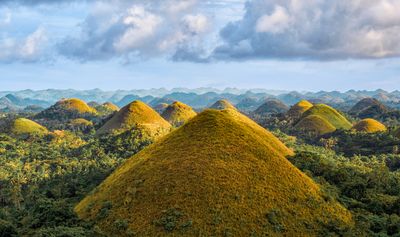


A gathering of mysterious cones dots the horizon of Bohol Island in the Philippines. These natural geological features formed over millions of years and their appearance changes with the seasons, which is where their name “Chocolate Hills” comes from.
While we’d love to share that this is where all Earth’s chocolate is grown, harvested from Teletubby-like mounds by a wacky-hat-wearing entrepreneur touting golden tickets, their name centers around dehydration. Rain peaks on the island during July and peters out towards the later end of winter. Its driest months are March and April, and when water is sparse, the luscious green mounds turn into the Chocolate Hills due to parched plants.
Beneath their grassy veneer are limestone and corals that were underwater along with the rest of the island around 2 million years ago. Back then, rich coral reefs covered the seabed – but once beached by plummeting sea levels, they dried up and sprouted a new terrestrial ecosystem. Their conical, mound-like shape emerged as erosion smoothed their edges.
There are thought to be between 1,200 to 1,700 Chocolate Hills spread across Bohol. Some of them stand at 120 meters (394 feet) tall, while others are a mere 30 meters (98 feet). Speaking of small things, Bohol is also home to tarsiers, one of the world’s smallest primates.
Tarsiers are about the size of your fist with disproportionately enormous eyes. It’s rumored that these peculiar primates were actually the inspiration for Star Wars’ Yoda, and it’s pretty easy to see the resemblance. Such enormous peepers are needed because they’re nocturnal animals, hunting at night for insects like spiders, beetles, termites, moths, and crickets. They just can’t get enough of creepy crawly leggy things, being the most insectivorous of all the primates.
Unfortunately, they’re also among the most endangered primates in the world, but Bohol is doing its bit to protect its boggle-eyed residents. The Philippine Tarsier Sanctuary can be found in the town of Corella, which is en route to the Chocolate Hills. Here you’ll meet a group of protected mini primates being cared for by local women who will also take you to see the tarsiers. Just remember to keep the noise down and your camera flash off, as these silky sweet animals are very sensitive.
Tarsiers are also fantastic singers, just in case The Mandalorian’s producers fancy adding a little extra color to Pedro Pascal’s little pal.
How to get there: The best route to Bohol’s Chocolate Hills is to fly into Cebu and take a ferry to the island. For the full chocolate experience, head over between March and June.
This article first appeared in Issue 10 of our digital magazine CURIOUS. Older issues of CURIOUS are free for all users. To access new issues, become an All Access Member.

 2
2