Nature
 PUBLISHED



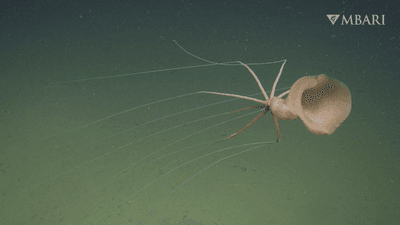


It’s no secret that there are a few among the IFLScience team for whom thinking about the deep sea risks an existential crisis. Fortunately, the folks over at the Monterey Bay Aquarium Research Institute (MBARI) are brave enough to do the deep diving for us, and hoo boy did they just spot one hell of a Pokémon in the wild.
The bigfin squid Magnapinna is something of a top trump for scientists exploring the ocean.
With extraordinarily long tentacles (complete with weird, elbow-like bends) and elusive behavior, they’re not a common sight. But when they do make an appearance, they put on one hell of a show.
Seeing it live really gives you an appreciation for how specialized and unique deep-sea animals are.
Olívia Soares Pereira
It was with considerable delight, then, that scientists recently observed a bigfin squid in the wild. They were onboard MBARI’S flagship research vessel David Packard on August 7 studying the Davidson Seamount.
Cruising offshore of central California, the goal was to study the ecology of the local seamounts and survey the seafloor. Then, a massive squid swooshed along and stole the limelight.
Team member and MBARI Postdoctoral Fellow Olívia Soares Pereira was screaming “Magnapinna!” before the creature had fully floated into view. A big reaction, sure, but then how would you feel if this deep-sea alien made a surprise appearance?
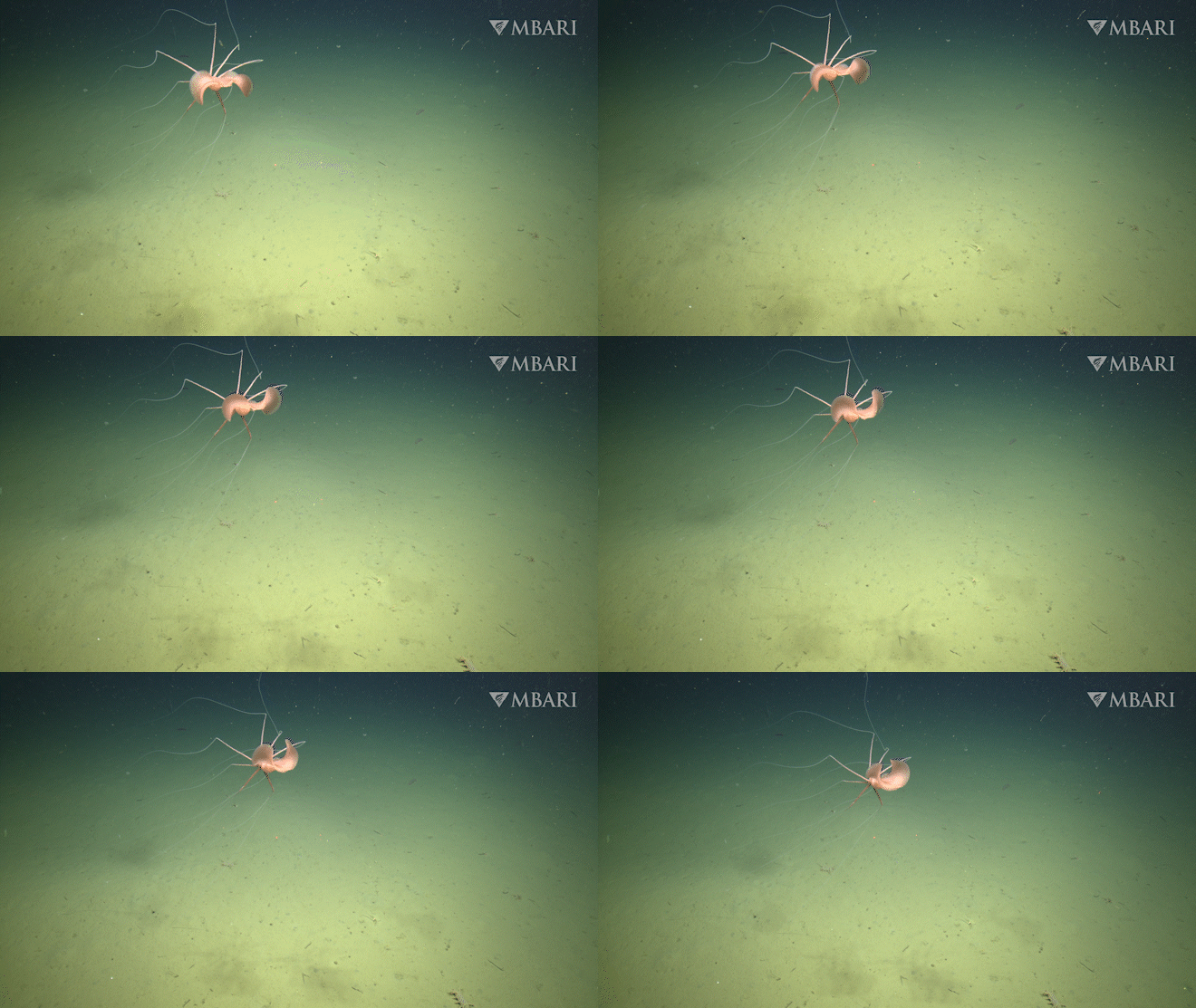
“What amazed me most was how effortlessly Magnapinna hovers above the seafloor while keeping those incredibly fine, long arms and tentacles extended,” Soares Pereira told IFLScience. “The ‘elbow’ pose is so unusual and characteristic of Magnapinna that seeing it live really gives you an appreciation for how specialized and unique deep-sea animals are.”
Those sticky-out arms are the source of much head scratching among scientists. One theory is that by holding their long filaments in this way, they’re better able to capture prey without getting everything tangled, a considerable risk when you're as noodly as these guys. But that is just a theory.
Seeing Magnapinna will always be a surprise, as it is such a rare sighting.
Olívia Soares Pereira
“We still don’t know exactly what this behavior is for,” said Soares Pereira. “Watching the animal maintain that pose and then swim so gracefully was one of those moments that really highlights how much we still have to learn about bigfin squid and life in the deep sea.”
The squid was hovering just off the muddy seafloor at a depth of 3,277 meters (10,751 feet) underwater – a region known as the midnight zone. This name stems from the fact that no light reaches this depth and so creatures here live in perpetual darkness.
It goes some way to explaining why, even with all our research ships and ROVs, we still have so much to learn about the deep sea. For Magnapinna, this latest sighting marks a first confirmed live observation of this remarkable squid in the northeastern Pacific Ocean. Very cool, albeit it not massively surprising.
“Seeing Magnapinna will always be a surprise, as it is such a rare sighting,” said Soares Pereira. “But I wouldn’t say it is completely unexpected to find it in this part of the Pacific, since the genus was initially described from a juvenile specimen collected from the Southern California margin.”
It’s a great reminder that every time we explore these environments, we can make unexpected discoveries.
Olívia Soares Pereira
“This encounter might extend the range by a bit, but what’s truly exciting is that this is the first confirmed live observation in the Northeastern Pacific.”
The encounter highlights what’s possible when scientists collaborate. A team effort from MBARI and the National Oceanic and Atmospheric Administration meant they had a suite of diverse technologies with which to explore this biodiversity hotspot.
A group project whose efforts were suitably rewarded.
“While we were investigating seafloor features that we believe may be created by feeding beaked whales, we encountered an animal we weren’t specifically looking for and still know very little about,” said Soares Pereira.
“It’s a great reminder that every time we explore these environments, we can make unexpected discoveries that can change our understanding of life in the largest living space on Earth.”
“The better we understand this environment and the animals that live there, the better resource managers and policymakers can protect deep-sea ecosystems.”

 1
1