Nature
 PUBLISHED


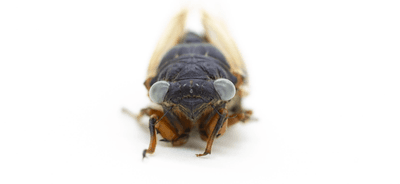


Among the countless cicadas emerging across the eastern US this spring as part of a rare double-brood emergence, a kid from Illinois stumbled across one extraordinary individual: a blue-eyed mutant.
Experts consider the special cicada to be “one in a million” as these cicadas' eyes are usually red, and it’s already been snapped up by the Field Museum of Natural History in Chicago where it will be on display until the end of June.
The blue-eyed cicada, a female belonging to the species Magicicada cassini, was first spotted by Jack Bailey in his family’s yard in Wheaton, Illinois, during this year’s double-brood cicadapocalypse event.
“My 4-year-old son, Jack, has been in heaven since they started emerging and has taken to collecting a lot of them. My daughter, Caroline, looked into his collection bucket and saw the blue-eyed one. She brought it inside and showed it to me,” Greta Bailey, the children’s mother, said in a statement.
“I thought it was cool and unique and had not heard that blue-eyed cicadas even existed. I took a few pictures and Caroline let it go. Well, after telling my family about it, we came to find out how rare they are and were kicking ourselves for not keeping it,” she added.
Upon realizing its rarity, the family searched the yard with flashlights and, remarkably, managed to find it again.
 Daniel Le, Field Museum.jpg "Greta, Jack, and Field Museum collections assistant Jim Louderman with the rare cicada.")
“One of our neighbors told us that the Field Museum is interested in the blue-eyed cicadas so I emailed the research and collections department last night in hopes that they would want it,” said Bailey.
The blue-eyed cicada has since died as these insects have very short lifespans once they emerge (RIP).
Almost all cicadas of this species have vibrant orange-red eyes, but an extremely small number have blue eyes, likely due to a rare genetic mutation. Little is known about the underlying cause of the blue eyes, but scientists at the Field Museum hope to sequence the DNA of the recently found bug to discover the genes responsible for its blue eyes.
 Daniel Le, Field Museum.jpg "A side view of the blue-eyed Magicicada cassin cicada")
It could be argued that 2024 is offering the best chance to find a blue-eyed cicada because this year is witnessing a rare double-brood event.
Cicadas spend most of their life underground, with groups known as broods only emerging once every 13 or 17 years. This year will be particularly dramatic as two broods of cicadas are about to synchronize their awakening for the first time in 221 years: Brood XIX, which has a 13-year life cycle, and Brood XIII, which has a 17-year life cycle.
The two broods are set to emerge across parts of Alabama, Arkansas, Georgia, Illinois, Indiana, Iowa, Kentucky, Louisiana, Michigan, Mississippi, Missouri, North Carolina, South Carolina, Tennessee, Oklahoma, Maryland, Wisconsin, and Virginia.
The emergence began earlier in May, but it might persist in some areas until late June – so keep your eyes peeled.
“I have been in Chicago for five periodical Cicada emergences of our BroodXIII, and this is the first blue-eyed cicada I have seen,” explained Jim Louderman, a collections assistant at the Field Museum.
“I have also seen two emergences of Brood X in Indiana and two emergences of Brood XIX in Central Illinois. These rare insect emergences are always infertile and can not have offspring, which is why they remain so rare."
If you are determined to find a blue-eyed bug, David Attenborough himself has a top tip on how to seduce a cicada that might be worth trying...