Nature
 PUBLISHED





An insect invasion in the trillions sounds like the stuff of sci-fi – but as early as next month, the US is set to see two mega-broods of cicadas rise up from the soil in a rare double emergence event.
If that sounds like your worst nightmare (or you’re hoping to witness the phenomenon), the US Department of Agriculture (USDA) has made a map that shows where the noisy insects are likely to pop up.
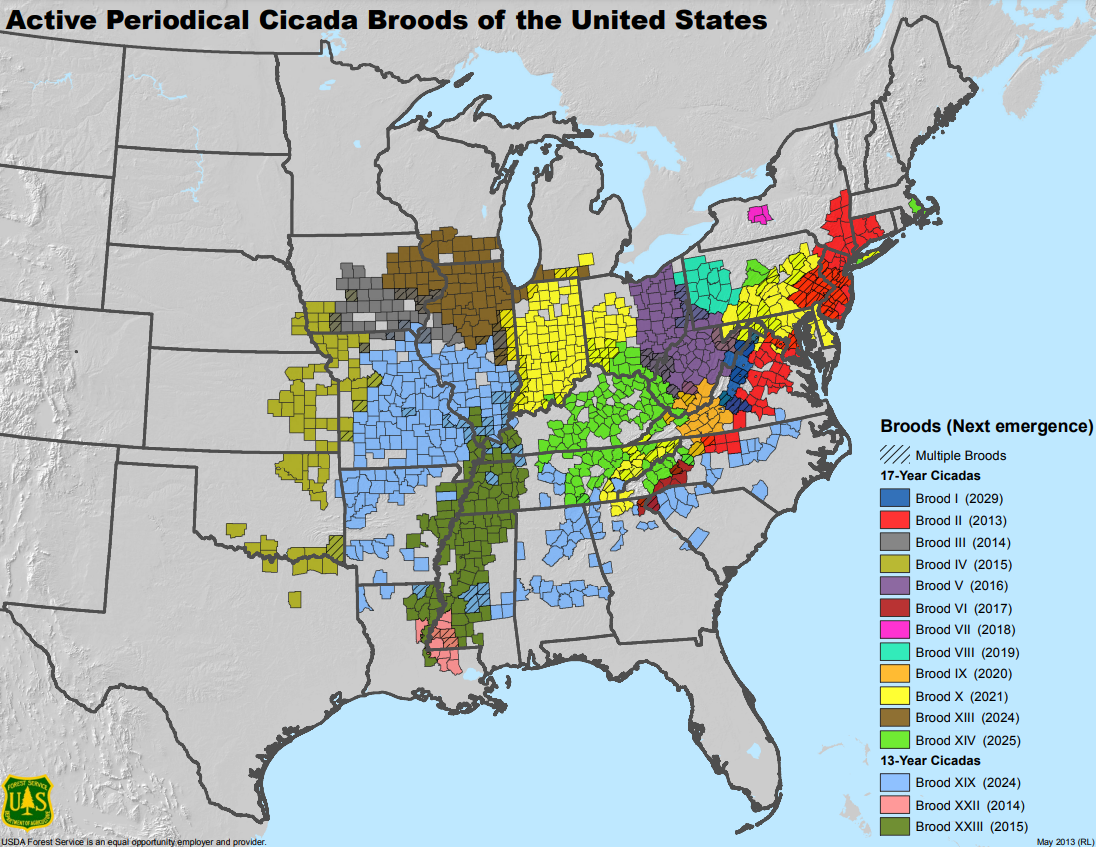
A total of 18 states are set to be affected by the emergence, which is made up of two groups; Brood XIX, which has a 13-year life cycle and is shown in blue on the map; and Brood XIII, which has a 17-year life cycle and is shown in brown on the map.
Periodical cicadas have long lives, but spend most of it underground, with groups known as broods only emerging once every 13 or 17 years. When they decide they’ve had enough of the dirt (ok it’s actually to do with temperature, but over a decade underground does sound quite dull) they wriggle out of the ground, shed their shells, and climb up nearby trees, ready to reproduce.
The two broods are set to emerge in the following states: Alabama, Arkansas, Georgia, Illinois, Indiana, Iowa, Kentucky, Louisiana, Michigan, Mississippi, Missouri, North Carolina, South Carolina, Tennessee, Oklahoma, Maryland, Wisconsin, and Virginia.
Such a double brood emergence is rare; it’s the first time in 221 years that the particular two broods of cicadas have emerged at once. That being said, according to the University of Connecticut and as the map shows, whilst there’s going to be a lot of cicadas overall, there won’t be a lot of overlap between the two broods.
“The state of Delaware is roughly 1.5 million acres in size. If we accept an estimate of a million cicadas per acre and if the total combined area of a periodical cicada emergence is roughly the size of Delaware, then more than a trillion cicadas will be involved,” the university’s periodical cicada information page states.
“For 2024, since cicadas will emerge from Maryland to Oklahoma, Illinois to Alabama, clearly, trillions of adult cicadas will be present – but not all in the same place at the same time.”
The emergence (very ominous sounding considering cicadas are harmless) is estimated to take place sometime in May to late June and once the cicadas are out, they’ll be around for about a month or so before they die – and they’ll certainly make themselves known before they do so.
"What happens is when you have this many cicadas - even if they're quieter in general than our dog day [cicadas] - all together in one place, then it can be deafening," cicada expert Catherine Dana told NBC Chicago.
That’ll stop you from napping the daytime – and maybe pop a raincoat on if you’re going to be outside with them, too.