Nature
 PUBLISHED


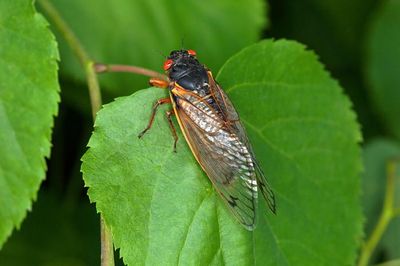


We talk a lot about eating insects but not so much about insects eating. However, a new study is set to change that as it puts to bed an enduring mystery surrounding cicada’s dietary habits. “Do adult cicadas eat?” is the question at the center of the long-standing scientific debate – and, as it turns out, they do.
“This question has been the subject of considerable historical debate, and, despite a sometimes-ambiguous scientific consensus to the contrary, it remains widely held among the general public that Magicicada do not feed as adults,” the study authors write in their paper.
Thanks to their research, this view has been proven to be a misconception: adult cicadas do in fact enjoy a bite to eat during their brief time above ground, nibbling on various plants’ sap – and frankly, good for them.
Cicadas are curious critters. They spend the vast majority of their lifecycle underground as nymphs, emerging as adults for just a few weeks to get their reproduction on before unceremoniously dying. Those in the North American genus Magicicada spend either 13 or 17 years in their subterranean surroundings, living off the sugary sap from tree roots.
Their emergence, in their billions, is quite a spectacle, but can pose a threat to US agriculture due to their ability to damage orchard trees. To better understand them, and solve the riddle of their feeding habits, researchers from the USDA’s Agricultural Research Service (ARS) turned to Brood X, a group of Magicicada that collectively emerged in 2021 in Maryland, Virginia, and West Virginia.
In a dietary analysis of nymphs, adults, and freshly emerged (teneral) adults from Brood X, the team found plant DNA in the guts of nymphs and adults, which was notably missing in the teneral adults.
"We tested teneral adults, or brand new adult Magicicada that had not had a chance to feed yet, to check for any leftover plant DNA," said USDA-ARS research team leader James Hepler in a statement. "We couldn't find any plant DNA in the guts of teneral adults, so we can be reasonably sure that the DNA found in mature adult Magicicada was eaten during the adult stage, since no DNA carries over from the nymph stage."
This, the team say, is enough to confirm that adult cicadas do get snacky during their short time above ground, taking a break from frantically procreating to munch on some sap.
Their nosh of choice? Sap from woody plants and apple trees – the analysis found that DNA from these plants was the most prevalent in the guts of adult Magicicada. But more than half of those tested appeared to eat multiple plant species.
So, adult cicadas like to eat – mystery solved – but, remember, if you have a seafood allergy, don’t be tempted to eat them.
The study is published in the Journal of Insect Science.