Nature
 PUBLISHED
 1
1


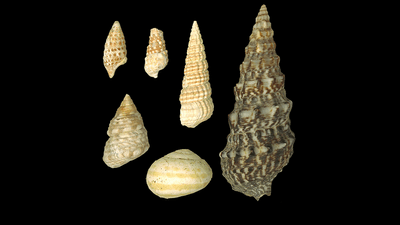


Colors in the natural world can come in just about every possible shade, from the bright blues of a peacock's tail feathers to the glow of an animal under ultraviolet light. Now researchers have found some of the earliest traces of the pigments that help produce the pretty colors in snail shells and they are around 12 million years old.
The snail shells – which belong to the family Cerithioidea – were found on the border between Austria and Hungary and date back to the Middle Miocene, when the area was at the edge of a tropical sea. While the shells did exhibit some red coloration, the team wasn’t sure what had caused it.
“It was unclear whether the patterns of reddish color were from the original shell or were formed by later processes in the sediment,” explained Professor Mathias Harzhauser at the Natural History Museum Vienna, who was involved in the discovery, in a statement.
Polyene pigments are found in abundance across the animal world and are involved in most red, yellow, and orange colors. However, they are particularly vulnerable to oxidation and because of this, do not preserve well in the fossil record.
The team decided to test whether these fossil shells contained such polyene pigments, particularly in four species, including Pithocerithium rubiginosum, several specimens of which have distinct red coloration.
To find out more about the pigments present in the shells, the team used a technique known as Raman spectroscopy, which involves irradiating samples from the shells with laser light. The light can then be used to identify chemical compounds.
The analysis revealed the presence of intact polyene pigments, which represents the first time this has been found in the fossil record.
“Normally, after such a long period of time, the best we can hope for is that there are traces of degradation products of these chemicals. If degraded, however, these compounds would be devoid of color. So, it was really surprising to discover these pigments, preserved almost intact, in fossils that are twelve million years old,” said study lead Dr Klaus Wolkenstein.
The team highlighted that this technique is especially non-destructive to the samples and might be useful for further screening to look for these pigments in other fossil specimens.
The study is published in Palaeontology.