Nature
 PUBLISHED
 3
3


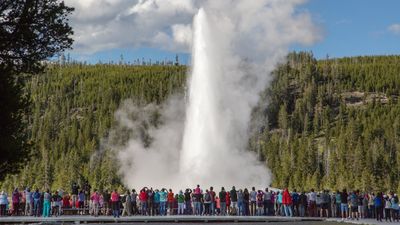


We finally have a good estimate of the volume of water Old Faithful pumps out with each eruption, as well as other measurements that remind us it isn't quite so faithful as you might think.
Despite being one of the world's most observed steam geysers, the volume of water spat out by Old Faithful in Yellowstone National Park, Wyoming, has remained stubbornly difficult for researchers to pin down.
This is because the water flows through several different channels whose output is influenced by the wind, and some of the water escapes as steam or otherwise evaporates before reaching a point where it can be measured.
Any estimate will vary widely because the volume is inconsistent between eruptions, so it isn't necessarily better to have a more specific single value.
But still, it's hard to be confident in the US National Park Service's estimate of 14 to 32 cubic meters (3,700 to 8,400 gallons) because they didn't write down how they got to that figure.
Now, scientists from the US Geological Survey, University of California (UC), Davis, UC Berkeley, and the National Park Service have quantified the total volume of water that erupted during 45 Old Faithful eruptions.
They calculated that the average discharge was 27.9 cubic meters (7,370 gallons) and varied from 12.2 to 44.3 cubic meters (3,223 to 11,703 gallons). More importantly, they documented exactly how they wrangled with the myriad ways water can exit the geyser.
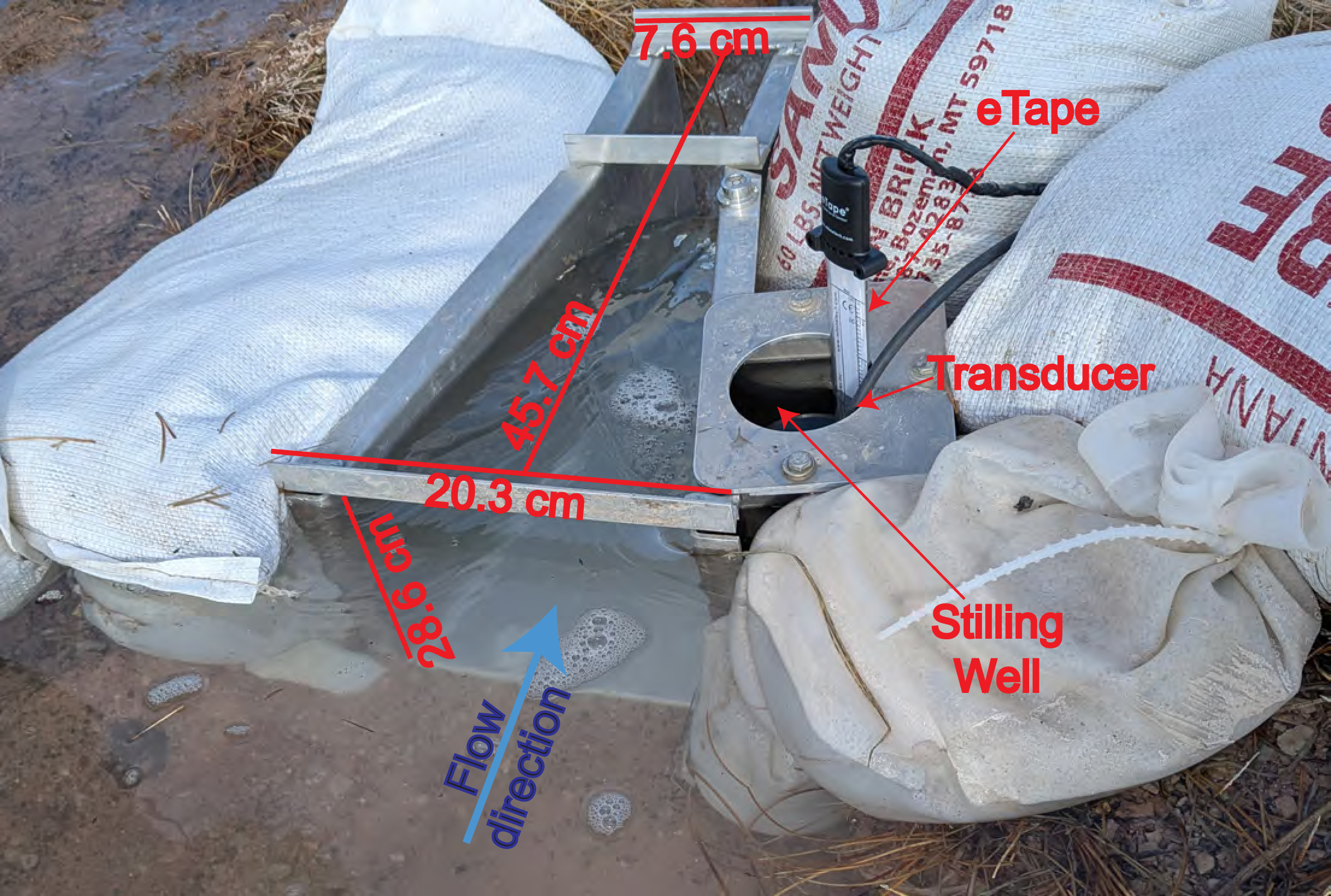
First of all, the researchers placed a "portable flume" in one of the geyser's outflow channels to measure the water that passed through it. They also took video of the geyser's steam plume so they could estimate its output. Lastly, they measured the "specific conductivity" of the water in the adjacent Firehole River.
Specific conductivity gives a readout of the mineral composition of the water, and because the geyser water is distinct from other sources entering the river, this can be used to estimate the geyser's output.
Taken all together, the researchers were able to come to an estimate that might be the best-defined yet.
"This means that an average Old Faithful eruption is equivalent to 4 to 5 concrete mixer trucks or about 140 standard household bathtubs!" note the authors of an article in the Yellowstone Caldera Chronicles, a weekly column from the US Geological Survey.
"It would take about 90 average Old Faithful eruptions to fill an Olympic-size swimming pool, which typically holds approximately 2,500 cubic meters (660,000 gallons)."
Despite Old Faithful's name, the researchers found that the intervals between the 45 eruptions they observed varied between 58 and 140 minutes, with a median and mean average of 99 and 93 minutes, respectively.
This isn't surprising, though, and falls in line with what observers of the geyser have known for years – Old Faithful isn't faithful in the sense of erupting to the exact same rhythm every time.
The geyser actually follows what researchers call a bimodal distribution, meaning it tends to erupt according to two different schedules – a short interval of around 60 minutes and a longer one of around 90 minutes.
Keeping tabs on the geyser's vital statistics like this can help provide a better understanding of its baseline behavior, which enables geologists to more easily detect changes due to earthquakes, climate variability, or infrastructure development.
The study is published in the Journal of Volcanology and Geothermal Research.
Correction: An earlier version of this article incorrectly stated that Old Faithful is in California. It has been corrected to Wyoming.