Space and Physics
 PUBLISHED




While the rest of the universe keeps sending us mysterious signals and little red dots from the dawn of time, it's easy to forget the astronomical wonders a little closer to home.
Last month, we had a newly discovered asteroid whizz past the Earth, close enough to be seen with amateur telescopes. This month will bring us a larger asteroid, this one discovered in 1997, that has not approached our planet this close since at least 1600 CE. As well as this, in June we had a little extra treat for space fans, taking place right here in our very own Solar System.
This one takes place fairly regularly, but not always so spectacularly. The Solar System's planets, as you are probably well aware, orbit at different rates. They are governed by Kepler’s third law, which states that the square of a planet's orbital period, or the time it takes to revolve around the Sun once, is directly proportional to the cube of the planet's average distance from our star.
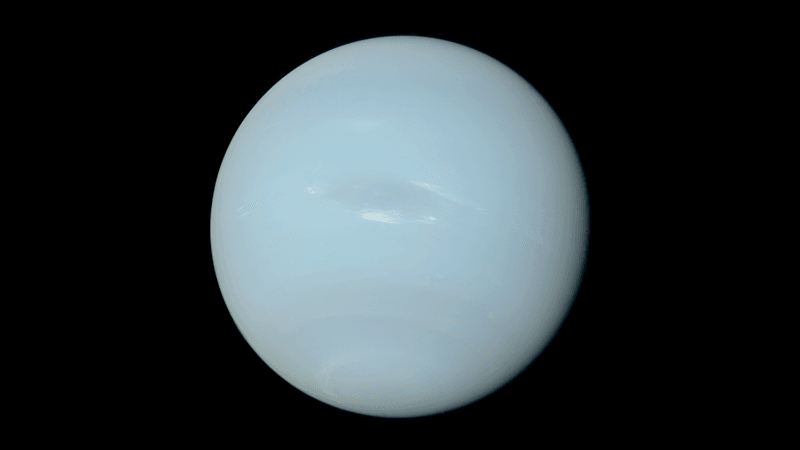
In short, the further out a planet is, the longer it takes for alien birthdays to occur. Mercury is whipped around the Sun by the Sun's gravity in just 88 Earth days, while if you grew up on Neptune, you would have to wait 60,190 Earth days, or around 165 Earth years, to celebrate one year on the ice giant.
"Though Kepler hadn't known about gravitation when he came up with his three laws, they were instrumental in Isaac Newton deriving his theory of universal gravitation, which explains the unknown force behind Kepler's Third Law," NASA explains.
"Kepler and his theories were crucial in the better understanding of our Solar System dynamics and as a springboard to newer theories that more accurately approximate our planetary orbits."
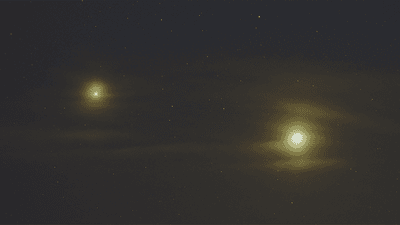
So what are we looking at in the photograph? The result of one planet "catching up" and aligning with another. Venus, a little closer to our star than us, takes 224.7 Earth days to orbit the Sun. Jupiter, meanwhile, takes 4,333 Earth days to complete its own orbit, or around 11.86 Earth years. As such, Venus "catches up" with slowcoach Jupiter – so that they are close to each other in the sky from our perspective – every 10 to 15 months.
Not all of these conjunctions are visible above the horizon, or they are too close to the Sun to be viewed properly. Every three years, give or take, the planets are far enough away from the Sun in our skies for us to get a good look at the two performing a "cosmic kiss", as captured by the Virtual Telescope, in the constellation of Gemini.