Nature
 PUBLISHED




“Life imitates art” might be an overused cliché, but a newly discovered gecko species found among rocks in the Western Ghats in India appears to be taking the phrase quite literally.
Back in April 2022, a team of researchers had set out on an expedition in the deciduous forests of the southern Western Ghats – an ecoregion in the south of India – on the hunt for members of Cnemaspis, a genus of geckos that are active during the day.
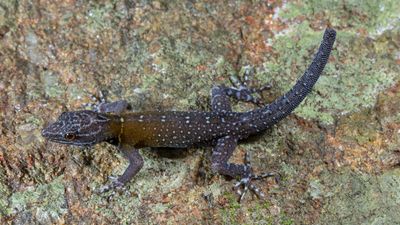
During their search, they came across a small lizard with a “striking colouration” on its back, made up of small blue dots, that they found to be reminiscent of Starry Night, one of Post-Impressionist painter Vincent van Gogh’s most famous works.
When the team discovered that the gecko they had found was a brand new species, they decided to name it after the painter, dubbing the little lizard Cnemaspis vangoghi. It was an impressive find to make, as the newly named gecko only measures around 3-4 centimeters (around 1-1.5 inches) in length.

It now joins an elite gang of van Gogh-inspired "Starry Night" creatures, alongside the Starry night harlequin toad and the Starry night peacock spider.
The researchers also identified another new gecko species, Cnemaspis sathuragiriensis – named after the hills it was found on – though both new species share some interesting characteristics.
“The two new species are distributed in low elevation (250–400 m asl.), deciduous forests of Srivilliputhur, and add to the five previously known endemic vertebrates from Srivilliputhur-Megamalai Tiger Reserve, Tamil Nadu, India,” explained study author Ishan Agarwal in a statement.
Both geckos were also mostly active during the early morning and evening and were primarily found on rocks – but they were also only found in a limited range. Specimens of C. vangoghi, for example, were only found in two areas within 15 kilometers (9 miles) of each other, which Agarwhal called “an interesting case of micro-endemism in low-elevation species.”
The discovery was made during a four-year survey that formed part of a wider project exploring the lizards of Tamil Nadu, a state well known not just for its cultural heritage (it’s home to four World Heritage Sites), but its rich array of flora and fauna.
“Tamil Nadu is an exceptionally biodiverse state,” said Agarwal. “We expect to name well over 50 new species of lizards by the time we are done [with our expeditions]!”
With the two new species of gecko described in the study, the team is already off to a good start – although making cool scientific discoveries doesn’t come without its downsides, apparently.
“I also had more than 500 tick bites during that summer trip, with the highest densities in the low-elevation, dry forests of Srivilliputhur, where the new species are found,” Argwhal recalled.
Some might argue the itchiness and risk of disease were worth it to find a gecko resembling an iconic artwork.
The study is published in ZooKeys.