Space and Physics
 PUBLISHED



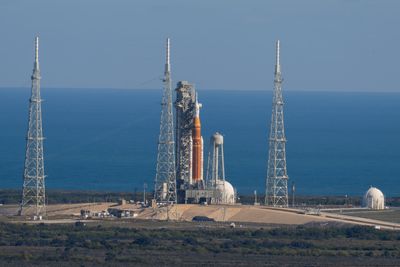


Space launches, especially crewed space launches, are planned to the very last detail. But there is one thing we can’t control: the weather. The wet rehearsal for the Space Launch System (SLS), the massive rocket of Artemis II, was expected to take place this weekend. Now, due to unfavorable weather conditions, the window for this series of tests starts at 9 pm EST on Monday, February 2.
“Over the past several days, engineers have been closely monitoring conditions as cold weather and winds move through Florida. Managers have assessed hardware capabilities against the projected forecast given the rare arctic outbreak affecting the state and decided to change the timeline,” NASA wrote in a press release.
“Teams and preparations at the launch pad remain ready for the wet dress rehearsal. However, adjusting the timeline for the test will position NASA for success during the rehearsal, as the expected weather this weekend would violate launch conditions.”
The wet rehearsal is the culmination of a series of tests to make sure everything is in tip-top shape for SLS and the Orion spacecraft. During that rehearsal, the cryogenic propellants are loaded into the rocket, and several runs take place to demonstrate the team's ability to hold, resume, and recycle the final 10 minutes of the countdown, all the way down to 30 seconds before launch (T-minus 30). If a problem were to arise, SLS and Orion would roll back into the Vehicle Assembly Building for further checks.
Before the mission teams can set a launch date, they need to see the results of the wet rehearsal. The shift to at least Monday means that both Friday, February 6, and Saturday, February 7, are no longer possible for launch. The earliest possible opportunity is Sunday, February 8.
If the date needs to shift further, there are two more possible launch dates in February: 10 and 11. After that, the Moon is not going to be in the right place in its orbit by the time the astronauts get there, so the launch will be postponed to March, where the possible dates are March 6, 7, 8, 9, and 11.
The Artemis II crew is composed of NASA's Reid Wiseman, Victor Glover, Christina Koch, and Canadian astronaut Jeremy Hansen. They are going to break records; there is the possibility that the crew will reach the farthest any human has ever traveled into space, and on their way back to Earth, they should take the title for the fastest humans have ever traveled in space too. The mission will last 10 days and will allow astronauts to see portions of the Moon that no other human has seen before with their own eyes.