Ad

nature-iconNaturenature-iconcreepy crawlies
clock-iconPUBLISHEDJune 4, 2024
comments icon1
share57

Move Over Daddy Longlegs, Meet The 48-Million-Year-Old Iridescent "Grandpa Longlegs"

I'd rather be shiny, like a harvestman from Eocene Germany.

Eleanor Higgs headshot

Eleanor Higgs

Eleanor Higgs headshot

Eleanor Higgs

Digital Content Creator

Eleanor has an undergraduate degree in zoology from the University of Reading and a master’s in wildlife documentary production from the University of Salford.

Digital Content Creator

Eleanor has an undergraduate degree in zoology from the University of Reading and a master’s in wildlife documentary production from the University of Salford.View full profile

Eleanor has an undergraduate degree in zoology from the University of Reading and a master’s in wildlife documentary production from the University of Salford.

View full profile
EditedbyFrancesca Benson
Francesca Benson headshot

Francesca Benson

Copy Editor and Staff Writer

Francesca has an MSci in Biochemistry from the University of Birmingham.

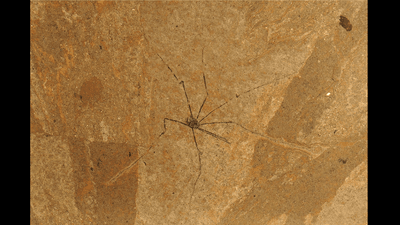
Spindly fossil harvestman embedded in brown rock

Leiobunum schaali, one of nine specimens found in Germany has a greenish iridescence

Image Credit: Bartel, C., et al. Palaeobiodiversity and Palaeoenvironments (2024) (CC BY 4.0)/Edited by IFLScience


Bright and shiny animals are all over the place, from deep sea worm species to electric blue tarantulas and even bright jellyfish. Now, several ancient harvestmen have been discovered in Germany, and the iridescence has even been preserved within the fossil. 

The rest of this article is behind a paywall. Please sign in or subscribe to access the full content.

This research marks the first fossil harvestmen discovered from the Eocene, roughly 48 million years ago. The specimens have the “daddy long legs” appearance with small bodies and long spindly legs. The team think that these ancient harvestmen belong to the family Sclerosomatidae, which is still around today. 

One of the specimins found in Germany. A full body photo is top left, with close ups showing the iridesents in the two right hand images and a graphic of the body plan in the left bottom image.
48 million years old and still shining.
Image Credit: Bartel, C., et al. Palaeobiodiversity and Palaeoenvironments (2024) CC BY 4.0

The specimens were found at the Messel Pit near Darmstadt in Hesse, Germany, which is usually more famous for revealing vertebrate fossils. In the middle Eocene, the area would have been subtropical to tropical forest. These specimens are the first fossil harvestmen to be described from the Messel Pit, though previously some arachnids and insects have also been found. They are the oldest fossil harvestmen from Germany, and the first fossil arachnids to have metallic iridescence preserved within the cuticle. 

Three photos of one of the fossils and a graphic of the body bottom left. Legs can be seen in the overview.
Leiobunum messelense, showing as the complete specimen and the body close up.
Image Credit: Bartel, C., et al (2024) Palaeobiodiversity and Palaeoenvironments CC BY 4.0

In total, the team looked at nine specimens. They were able to place the harvestmen in the family Sclerosomatidea based on a few key details such as the pedipalp claw being pectinate and the top side of the opisthosoma being fused into a single plate. 

The iridescence seen on the fossils reminds the researchers of a living family of modern harvestmen that belong to the Gagrellinae subfamily. Currently, the subfamily contains around 1,000 species, across the Neotropics and northern Australia, and Malaysia. 

The paper is published in the journal Palaeobiodiversity and Palaeoenvironments.


Written by 

Add us as a Google preferred source to see more of our
trusted coverage in Search