


 Nature
 PUBLISHED


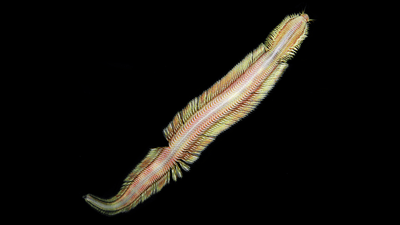


A new-to-science worm has been found in the deep sea near a methane seep off the coast of Costa Rica. If that’s not enough buzzwords to get your chops around, it also has massive jaws, feathery gill-carrying appendages, and has been described by its namesake as a “living magic carpet”.
The deep-sea worm has been officially named Pectinereis strickrotti after Woods Hole Oceanographic Institution’s Bruce Strickrott, lead pilot for the famed deep-sea submersible Alvin. Stickrott was riding in Alvin at a depth of 1,000 meters (3,280 feet) with Greg Rouse, a marine biologist at UC San Diego’s Scripps Institution of Oceanography, back in 2009 when they first spotted the worm.
“We saw two worms near each other about a sub’s length away swimming just off the bottom,” said Strickrott in a statement. “We couldn’t see them well and tried to creep in for a closer look, but it’s hard to creep in a submarine and we spooked them.”
The worms were undulating around Costa Rica’s methane seeps, sections of the seafloor where gas bubbles up from the rocky bed. They’re not especially hot, like hydrothermal vents, but the animal life is unusual as it subsists on chemical energy, rather than needing sunlight.
The animals here have overcome the lack of light thanks to microbes that evolved to eat methane, forming the base of a food web that ranges from mussels and crabs to soft-bodied worms like our dazzling P. stickrotti.
The species remained elusive until 2018 when a return dive to the same mound where the worms were first sighted turned up six more individuals. Using a piece of kit affectionately known as the “slurp gun,” they were able to suck up some specimens and finally give it a formal name.
“The way this thing moved was so graceful, I thought it looked like a living magic carpet,” added Stickrott. “I’m honored that Greg [Rouse] saw fit to name this species after me, it means a lot.”
The worm’s elongated body is lined by feathery, gill-tipped appendages known as parapodia. It has a sinuous swimming technique that reminded Rouse of a snake and also packs impressively large jaws, though exactly what it’s eating remains a mystery for now.
The discovery of P. stickrotti raises the number of new species found in this seemingly inhospitable environment to 48, and the team hopes to return to the water in search of deep-sea discoveries, this time at methane seeps off the coasts of Alaska and Chile.
The study is published in PLOS ONE.



 1
1