Nature
 PUBLISHED


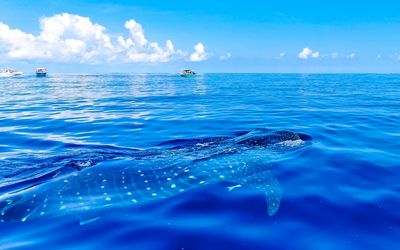


Many animals are capable of extraordinarily long migrations, crossing many miles of Earth’s seas, skies, or scenery to reach breeding or feeding ground. While these journeys are impressive, there are always a few stand-out individuals that seem to push farther than the rest, as is the case with a whale shark who swam a 1,200-kilometer journey between Madagascar and the Seychelles.
A juvenile male whale shark (Rhincodon typus), first recorded off Nosy Be, Madagascar in 2019, was then seen off Mahé in Seychelles in August 2025. Whale sharks are listed as Endangered by the IUCN but have a large range and can be seen in most warm-temperature ocean regions. It is even thought that, due to climate change and warming oceans, their range is spreading into European waters.
“We’ve been recording whale sharks since 2015 and to see an individual travelling more than 1,200 km [746 miles] between Madagascar and Seychelles is astounding. This first-of-its-kind event is what we were waiting for,” said Stella Diamant of the Madagascar Whale Shark Project in a statement.
The Madagascar Whale Shark Project has a database of whale shark photographs that have been taken over the years by citizen scientists, tour operators, and Malagasy students. These photos were compared to ones taken by the Marine Conservation Society Seychelles, helping to identify the individual as MD-393 Mistral, a 4.5-meter-long (14-foot) male that was recorded on November 26, 2015, feeding off the coast of Nosy Be.
One August 29, 2025, the same individual was photographed as a 6-meter-long (19-foot) male in the waters of Mahé, Seychelles. “This is the first resighting of a whale shark from Madagascar in another western Indian Ocean country,” explain the authors.
This movement between Madagascar and Seychelles could suggest that juvenile whale sharks are motivated by prey availability and are willing to travel long distances. Many whale sharks return to Nosy Be seasonally and can travel several thousand kilometers down the coastline for years before returning.
“This discovery underscores the importance of long-term monitoring and international collaboration. Without shared photo-identification databases, this movement would have gone unnoticed," said Diamant.
Whale sharks are vulnerable to boat strikes and being caught as bycatch by tuna fisheries. While they are a protected species in Seychelles, no such formal protection is in place in Madagascar. The study highlights the importance of both long-term monitoring projects and cross-country cooperation, as the authors plan to share photo identification data to learn more about this endangered species.
The study is published in the journal Oryx.