Nature
 PUBLISHED



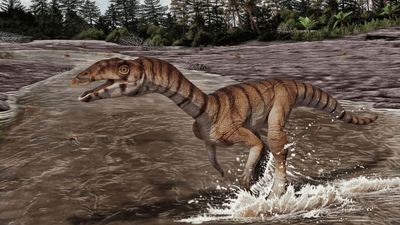


When you think of crocodiles, what comes to mind? Big jaws? Sharp teeth? A log-like body on four legs? It might surprise you, then, to learn of an ancestor of theirs that’s just been described as a new species. Dating back 212 million years, it had no teeth, a beak, and walked on two feet.
Yes, not very croc-like at all.
Meet Labrujasuchus expectatus, AKA the “Witch Croc," the newest member of the Shuvosauridae that’s being celebrated for its weirdness. Shuvosauridae are an extinct family of reptiles that looked similar to short-armed theropod dinosaurs. In fact, they came from the branch of archosaurs that led to crocodiles, but you could be forgiven for not knowing that just by looking at one.
We don’t know for sure what Labrujasuchus was doing with its beak.
Nathan Smith
By all accounts, Labrujasuchus was a bit of an oddball. Dating back to the dawn of the dinosaurs, it was a time of many strange animals, such as Atopodentatus, the vacuum-shaped sea monster, and Longisquama, which you really need to see to believe.
At least being a crocodile ancestor with no teeth and a beak gets you noticed in the palaeontological community, so perhaps it was worth being such an odd duck just for that.
The animal's beak is an example of convergent evolution – where unrelated animals independently evolve similar features. Many other tetrapods have evolved a beak, including the ornithomimosaur dinosaurs that had beaks very similar to those of shuvosaurids despite living many millions of years later during the Cretaceous.
As for what Labrujasuchus actually used its beak for, that remains to be seen.
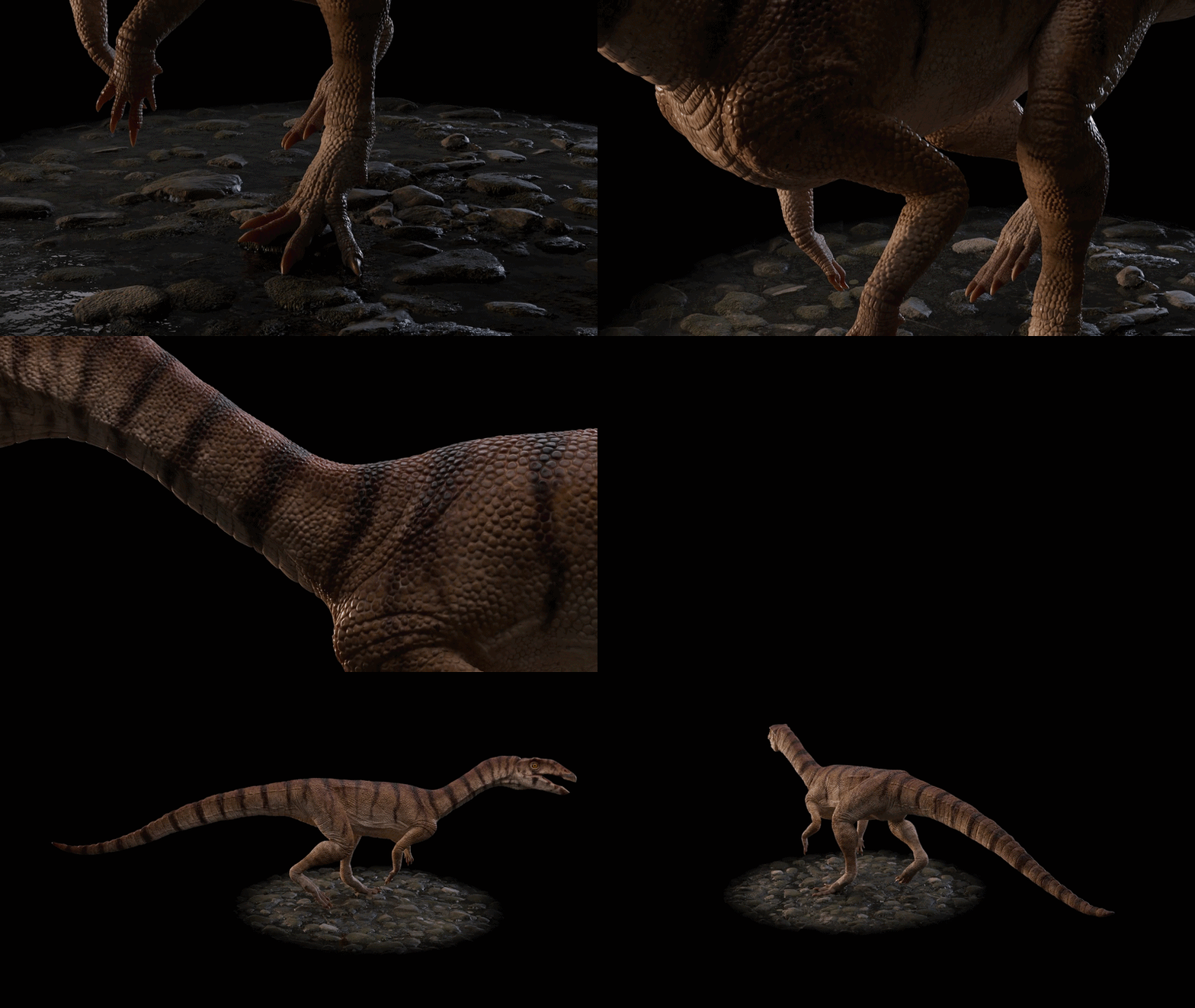
“We don’t know for sure what Labrujasuchus was doing with its beak, but some studies of its relatives suggest shuvosaur lower jaws were relatively weak, and they may have specialized on soft plant material,” said study author Nathan Smith at the Natural History Museum of Los Angeles County. “Only more fossils and more research will tell!”
To the modern human, a crocodile on two legs is pretty hard to picture, but in truth their ancestors were up to all sorts. Some of them were fast runners, others lived in trees, and yes – just like the shuvosaurs – some walked on two feet.
"We see a lot of the successful strategies for modern animals and non-avian dinosaurs first arise in the Triassic, and shuvosaurs are a great example of that convergent evolution,” said lead author Alan Turner at Stony Brook University in New York in a statement.
“Bipedalism is certainly a unique path for crocodile relatives to take, but it’s a path well-trod by dinosaurs and later birds. It obviously worked for these animals.”
Labrujasuchus arrives as a long-awaited surprise. Sandwiched in time between two shuvosaurs previously discovered in the region, it is a link palaeontologists had been waiting to find. The expected unexpected, if you please, hence the name "expectatus."
The first part of its name comes from a reference to the Ranchos de los Brujos (meaning Ranch of Witches), which is what Ghost Ranch, near where the fossil was found, used to be called. According to Smith, legend has it the name was a trick by rancheros to keep people away from the cattle-rustling operations of the Archuleta brothers.
“We wanted to give a nod to that colorful history, and honor the incredible role Ghost Ranch has played in expanding our view of the Triassic,” he said. “We also wanted to highlight how the fossil record works – finding one shuvosaur from earlier in the Triassic and one from later meant that we paleontologists knew there were probably more from in-between waiting to be discovered and described.”
The historic ranch has been a site of palaeontological investigations for a century, with Smith’s team working there for the past 20 years. They are celebrating Labrujasuchus not just as a bit of a Triassic weirdo, but also for the milestone it represents.
There are surely plenty more weirdos waiting to be discovered at the Ranch of the Witches.
The study is published in the Journal of Vertebrate Paleontology.


 1
1