Nature
 PUBLISHED
 2
2


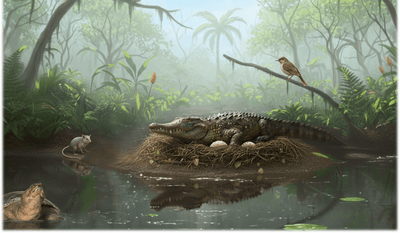


Paleontologists have confirmed their suspicions that Australia once had crocodiles that roamed forests and probably climbed trees, to jump on potential prey. Although evidence for this conclusion has come from several sources, the final piece of the puzzle was provided by an apparently unlikely source: eggshells.
Australians are fond of scaring tourists with tales of drop bears, mythical carnivorous koala relatives that plummet from trees to bite the throats of unwary passers-by. So unusual are real Australian animals that some people see no reason to doubt it, and it turns out something much more unexpected probably once adopted a similar hunting approach: crocodiles.
Professor Mike Archer of the University of New South Wales doesn’t think giant reptiles the size of modern saltwater crocs once hunted from trees. He told IFLScience this approach was probably restricted to animals no more than 1.5 meters (5 feet) long, about the length of the largest goannas (Australian lizards) that do something similar today.
That doesn’t mean the forests would have been safe for anything too big to be tackled by these tree-climbing crocs, however, since some members of the forest-dwelling family grew to 6 meters (20 feet) long. Moreover, they shared the rainforests with “Large madtsoiid snakes, venomous varanid lizards, and carnivorous marsupials,” Archer and co-authors of a new paper write.
These were mekosuchine crocodiles, from a different branch of that ancient order than those that haunt waterways today. They thrived across Australia for tens of millions of years, and even spread to South Pacific islands like Fiji. Their ocean-crossing capacity proves mekosuchine crocs were capable swimmers, but some of their features and the places where some bones have been found led paleontologists to suspect they spent plenty of time away from water.
Proof came in the form of the oldest crocodilian eggshells in Australia, collected at Murgon, Queensland. “We had lots of information about these crocs, but none of it told us about the nature of the lake they were found in,” Archer explained to IFLScience. “The chemistry of these eggshells demonstrated they dried out, which means this was not simply an aquatic damp environment.” Fishbones found in the same place are abundant, but small. Together, these indicate the lake dried out seasonally, preventing the fish from growing large and causing the eggshells to dry, probably after their occupants hatched.
Someone just sent me a photo of a surprisingly large croc in a tree, but now it is about necessity, not opportunity.
Prof Michael Archer
“These eggshells have given us a glimpse of the intimate life history of mekosuchines,” said lead author Xavier Panadès i Blas, PhD student at Institut Catala de Paleontologia Miquest Crusafont, in a statement.
Crocodiles would have no benefit from hanging around a dried-out swamp. Archer told IFLScience that botanical studies have provided no evidence for grasslands in Australia before 3.5 million years ago. Until then, the continent was overwhelmingly forested, with rainforest mostly dominant, so the crocodiles would have needed to move among the trees, rather than hunting in long grass. For the newly hatched crocs, up a tree was probably the safest place until they grew large enough to have few predators.
Archer noted to IFLScience that even modern crocodiles can climb trees, although they usually do it to evade less equipped predators. “Someone just sent me a photo of a surprisingly large croc in a tree, but now it is about necessity, not opportunity,” he added.
Mekosuchine crocodiles survived at least until 24,000 years ago, during the Ice Age, but by that point, they had been in decline for a long time. Archer says it is possible that the arrival from Asia of modern crocodiles and modern lizard families squeezed them out of both their ecological niches.
The Mekosuchine crocodiles had plenty of fearsome competitors. However, Archer told IFLScience that during their reign, Australia was three times as biodiverse as it is today, reaching a density of species only the Amazon and Borneo match today. “They would have had to work out how to specialize in food resources to reduce competition. They also had quite diverse skull shapes, so may have even avoided competition among themselves.”
Archer told IFLScience that studying fossils from Australia’s rainforest era is about more than wistful pining after a lost world. “All modern Australian mammal groups have their ancestors at Riversleigh,” Archer said, referring to the fossil treasure trove that revolutionized Australian paleontology. “It shows the rainforests are a green cradle for diversity and the arid-adapted species today.” This offers hope that the continent’s animals can recover from the current destruction, if the remaining patches of rainforest are preserved.
The eggshells were among many fossils found at Murgon. Archer and colleagues were alerted to the site’s potential when the local sheep farmer sent some bones he had found to the Queensland Museum, where they were recognized as being from soft-shell turtles.
Archer admitted to IFLScience he still doesn’t know why some turtles would evolve a defense as useful as a hard shell, and then abandon it for a soft one, but soft-shell turtles survive in Asia today. Archer and colleagues thought the turtles must be part of an interesting ecosystem and sought permission to dig. “This forest was also home to the world’s oldest-known songbirds, Australia’s earliest frogs and snakes, a wide range of small mammals with South American links, as well as one of the world’s oldest known bats,” Archer said.
No wonder the farmer enjoyed sitting by the side of the site watching the paleontologists’ work, sometimes becoming so excited at a discovery that his wife eventually banned him for fear his heart couldn’t handle it.
The study is published in the Journal of Vertebrate Paleontology