Nature
 PUBLISHED


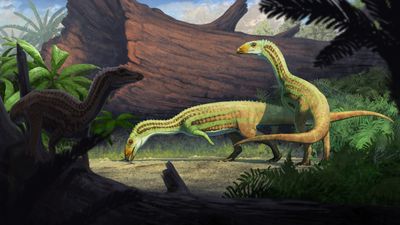


Crocodiles are famous for having barely changed for millions of years, but that wasn’t always the case. In the Late Triassic, one early crocodile relative took to walking on two legs as adults, and might have fooled a time-traveler into believing they were dinosaurs. To show they hadn’t entirely abandoned their crocodilian heritage, the genus named Sonselasuchus still got around on all fours while juveniles.
Fossils found in Arizona’s famous Petrified Forest National Park, dating back about 216 million years, presented a puzzle. Although small, with 950 bones found from at least 36 individuals, these clearly came from a successful species, at least locally.
The bones carried enough distinctive features to identify them as part of the shuvosaurid group, archosaurs whose descendants are crocodiles and their relatives, but attempts at reconstruction produced something that looked more like a very small dinosaur. The hindlimbs were longer than the forelimbs, indicating they were bipedal, and probably stood about 63.5 centimeters (25 inches) high.
However, lead author and University of Washington graduate student Elliott Armour Smith said in a statement, “By analyzing the proportions of the limb skeletons of different animals, they determined its bipedal stance (standing on two feet) may have been the result of a differential growth pattern.”
Like the pigs in Animal Farm, Sonselasuchus started out on all fours, with limbs of equal size, but shifted to an upright stance as their hindlegs grew longer. “This is particularly peculiar,” Armour Smith said.
Three shuvosaurid species have previously been described, all of them showing features that look theropod-like, including suspected bipedalism. However, we lack the fossil richness for the other species to know if they walked on all fours when young.
“Although similar to the ornithomimid dinosaurs these features would have evolved separately,” Armour Smith said. “And this similarity was probably due to the fact that croc-line and bird-line archosaurs evolved in the same ecosystems and converged upon similar ecological roles. Also, despite the fact that features like bipedalism, a toothless beak, hollow bones and a large orbit are characteristic of ornithomimid theropod dinosaurs, shuvosaurids like Sonselasuchus show that these features evolved on the croc-line as well.”
Smith and co-authors named the genus Sonselasuchus after the Sonsela geological unit in which the specimens were found. The species name, cedrus, given to the only currently known Sonselasuchus, refers to the cedar tree, reflecting the fact that they probably lived in the evergreen conifer forests of the Late Triassic.
“Since starting fieldwork at Petrified Forest in 2014, we have collected over 3,000 fossils from the Sonselasuchus bonebed, and it doesn’t seem to show any signs of petering out,” said study author Professor Christian Sidor. “In addition to Sonselasuchus, the bonebed has yielded fossils of fish, amphibians, as well as dinosaurs and other reptiles. Over 30 University of Washington students and volunteers have been involved over the years. It’s exciting to see that the site continues to produce new and interesting fossils.”
More than 100 other specimens that have been identified as shuvosaurids have been reported in scientific papers, particularly in the southwestern USA, but not allocated to a new or existing species. That’s usually because paleontologists are reluctant to describe new species without skulls. However, the numbers indicate that these apparent weirdos may have been quite widespread and diverse.
The study is published in the Journal of Vertebrate Paleontology.