Space and Physics
 PUBLISHED



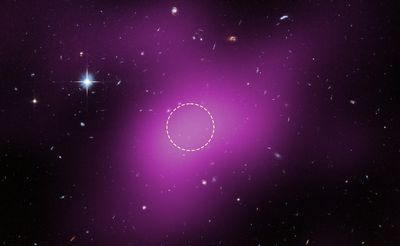


Galaxies without stars might seem like a contradiction. Aren’t galaxies supposed to be islands of stars, gas, planets, and more? Well, maybe this newly discovered object should be called a failed galaxy… it has some of the hallmarks of galaxies, dark matter, and gas, namely, but it did fail to form any stars. Meet Cloud-9.
Cloud-9 is the first of a new class of objects called RELHICs or Reionization Limited HI Clouds, which are thought to be clouds of dark matter.
Dark matter is a hypothetical substance that only interacts with gravity and not light, so it is invisible to us. Leading cosmological models suggest that dark matter began clumping up before regular matter. These dark matter halos came in a wide range of masses. In the largest ones, galaxies formed. The smallest ones, simply known as dark halos, tend to be too small to form stars, but they can be big enough to hold onto gas.
“Cloud-9 lies at the very upper end of the dark halo mass range, thus allowing it to retain its gas (as a RELHIC object), and therefore being visible through radio observations,” lead author Gagandeep Anand of the Space Telescope Science Institute (STScI) told IFLScience.
“If Cloud-9 were more massive, it would collapse and form stars, becoming a galaxy. If it were less massive, the gas would fall apart and be blown away. This cloud sits in the “sweet spot”, neither too massive nor too small,” Andrew Fox of AURA/STScI for the European Space Agency told IFLScience.
Cloud-9 is a cloud of hydrogen 1 million times the mass of the Sun, 14 million light-years from Earth, and it is about 4,900 light-years across. It is heavily dominated by dark matter; instead of the 5:1 ratio for regular galaxies, this is closer to 5000:1, meaning it has 5 billion solar masses worth of dark matter.
“A cloud this size needs a source of gravity to hold it together. There are no stars to provide this gravity, and the neutral hydrogen gas does not contain enough mass, so dark matter must be the culprit. Without it, the cloud would simply fall apart,” Fox told IFLScience.
“This evidence for dark matter is what makes Cloud-9 so fascinating. Theories of galaxy formation predicted that there is a minimum threshold of dark matter required to ignite star formation and turn a dark cloud into a luminous galaxy. With Cloud-9, we have an example of an object just below this threshold, containing no stars. And the new Hubble Observations were critical here – they showed that there are no detectable stars in the cloud, down to very sensitive (faint) levels.”
The mass plays a role in the survival of the RELHICs, but as is often the case, location matters too. Cloud-9 is isolated, located 260,000 light-years from the spiral galaxy Messier 94 (M94). The distance allowed it to go on undisturbed.
“In short, Cloud-9 is unique because it has just the right mass and just the right location,” Fox told IFLScience.
This makes objects like Cloud-9 fairly rare – and not easy to find. Radio telescopes are key to spotting the hallmarks of glowing neutral hydrogen, but these possible RELHICs, by their very nature, are neither flashy nor big. Only recently have telescopes become sensitive enough to spot candidates.
“Their neutral hydrogen content means they do glow in the radio, but only recently have radio observatories such as the Chinese FAST telescope (which first uncovered Cloud-9) begun to find candidate RELHICs. However, to verify that Cloud-9 was indeed a RELHIC object, we needed to confirm its starless nature, which we have now done with the Hubble Space Telescope,” Anand told IFLScience.
While Cloud-9 is the first confirmed RELHIC candidate, it is not the first starless galaxy. Back in 2024, astronomers announced the discovery of J0613+52, a galaxy located 270 million light-years away, and it appears to have no stars, just a big blob of rotating gas. Despite both having no stars and just a lot of hydrogen, the objects are very different.
“That also appears to be a 'failed galaxy', but that object is different from Cloud-9 [in] two key ways. First, it is rotating like a disk, whereas Cloud 9 shows no rotation at all. Second, it is much more massive than Cloud 9, with about 1000x more gas mass. So they cover very different mass scales,” Fox told IFLScience.
The universe might have more pathways to make galaxies fail at making stars.
The study is published in The Astrophysical Journal Letters.