Space and Physics
 PUBLISHED
 1
1



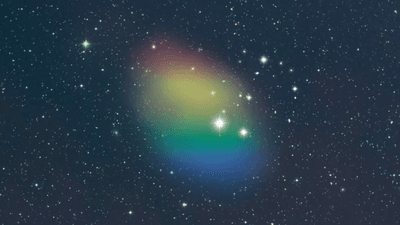


When we think of galaxies, we often think of bright spiral galaxies full of stars and gas – but some galaxies have very few stars and look quite different. These are known as low-surface-brightness galaxies. They tend to have a lot more dark matter than regular galaxies like our own, and the normal matter they have is usually in the form of gas, with few stars.
Astronomers were conducting a survey of 350 of these galaxies using the Green Bank Telescope (GBT), a world-class radio observatory. when they accidentally spotted an extreme example of this. J0613+52 is located 270 million light-years away and it appears to have no stars. Just a big blob of rotating gas.
“The GBT was accidentally pointed to the wrong coordinates and found this object. It’s a galaxy made only out of gas — it has no visible stars. Stars could be there, we just can’t see them,” Karen O’Neil, senior scientist of the Green Bank Observatory, said in a statement.
The team was using multiple telescopes to study the properties of the 350 galaxies when they stumbled on this unique object. Gas is the fuel to make new stars, but it needs to be close together for gravity to take over and stars to be born. This doesn’t seem to be happening in the case of J0613+52.
“What we do know is that it’s an incredibly gas rich galaxy. It’s not demonstrating star formation like we’d expect, probably because its gas is too diffuse. At the same time, it’s too far from other galaxies for them to help trigger star formation through any encounters. J0613+52 appears to be both undisturbed and underdeveloped. This could be our first discovery of a nearby galaxy made up of primordial gas,” added O’Neil.
This galaxy is truly a fascinating riddle. Researchers believe that it would be important to follow up on this object with deep optical observations to find the stars that might exist in this galaxy. However, the astronomers feel that it would be important to find more objects like this one using radio observatories.
“A full sky survey by an extremely sensitive instrument like the Green Bank Telescope could uncover more of these objects,” O’Neil suggested.
The serendipitous discovery was presented at the 243rd meeting of the American Astronomical Society.