Space and Physics
 PUBLISHED



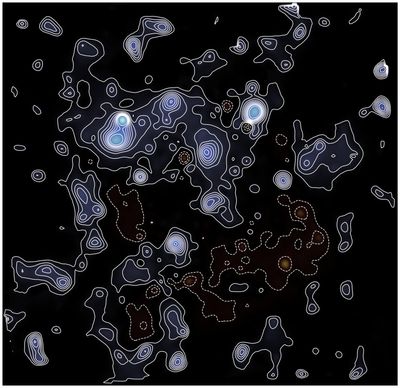


A cornerstone component of our model of the universe is the existence of dark matter. We have not yet proven that this hypothetical substance exists, but observations and models have made a pretty strong case for it. Dark matter doesn’t interact directly with light, but it has mass, so it interacts with gravity. Its gravitational pull can warp spacetime. By tracking the slight distortion of distant galaxies due to this warping, researchers have been able to create the sharpest map of dark matter yet.
Crucial to this were observations from JWST. The space telescope was able to significantly build upon previous work. Astronomers conducted observations on an area of the sky about 2.5 times larger than the full Moon, in the constellation Sextans. It contains about 800,000 galaxies, many of which had been invisible before. It includes as many as 10 times more galaxies compared with maps of the same area from ground-based observatories, and twice as many as the Hubble Space Telescope had seen.
The team analyzed the shapes of 250,000 galaxies and reconstructed how dark matter warped spacetime and altered their shapes. This led to the construction of the incredible map, which is consistent with the model. It suggests that dark and regular matter were well distributed after the Big Bang. Minor overdensities in the distribution led dark matter to clump up first. Afterwards, these dark matter halos pulled in the regular matter that ended up making stars and galaxies.
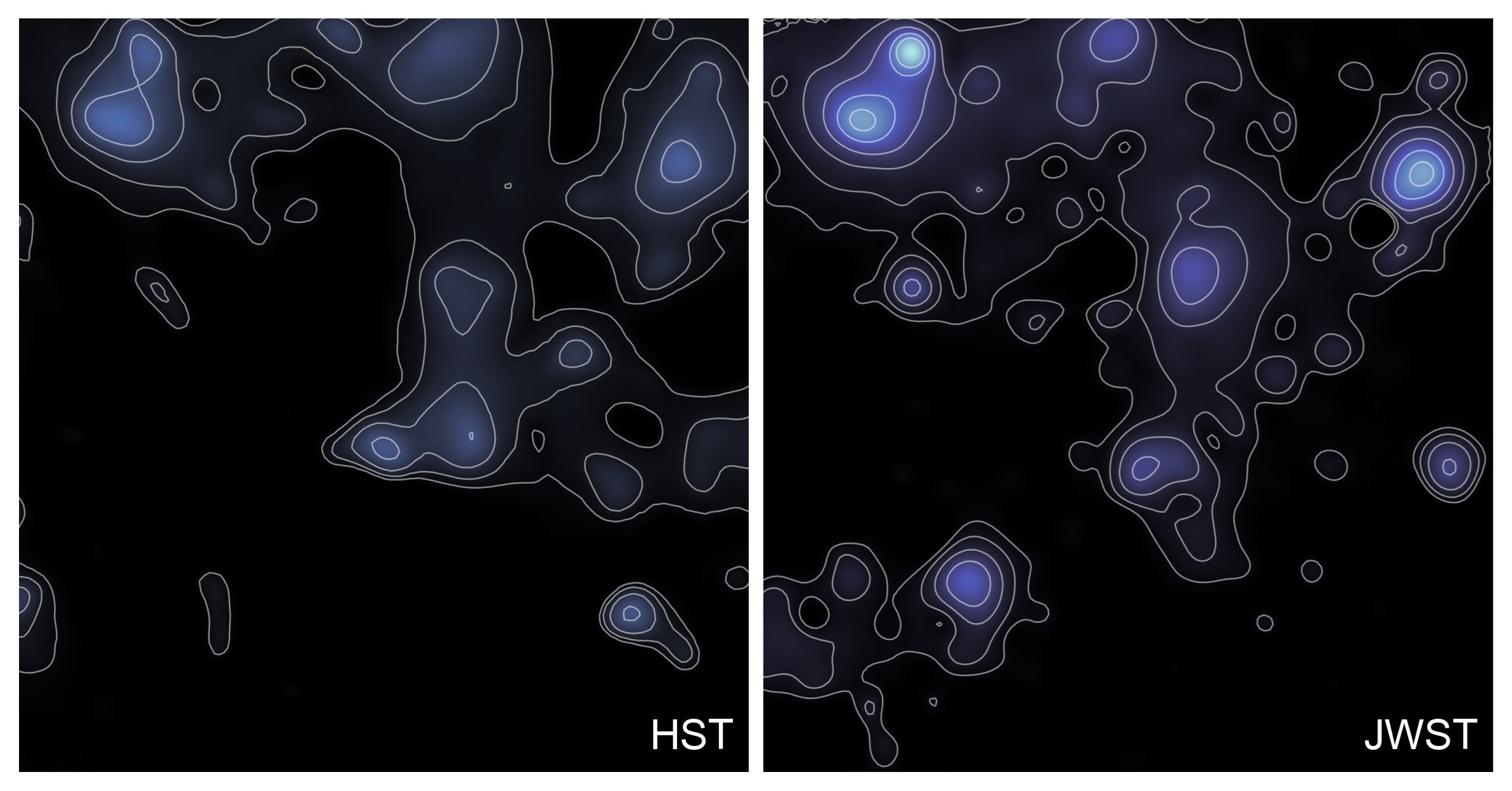
“By revealing dark matter with unprecedented precision, our map shows how an invisible component of the Universe has structured visible matter to the point of enabling the emergence of galaxies, stars, and ultimately life itself,” research co-lead author Dr Gavin Leroy, from Durham University, said in a statement.
"This map reveals the invisible but essential role of dark matter, the true architect of the universe, which gradually organises the structures we observe through our telescopes.”
If dark matter is real, particles of dark matter are all around us – they simply hardly ever interact with regular matter. This is why we have built very sensitive detectors trying to catch these incredibly rare events. So far, we have not seen any.
“Wherever you find normal matter in the universe today, you also find dark matter. Billions of dark matter particles pass through your body every second. There’s no harm, they don’t notice us and just keep going,” added co-author Professor Richard Massey, also from Durham University.
“But the whole swirling cloud of dark matter around the Milky Way has enough gravity to hold our entire galaxy together. Without dark matter, the Milky Way would spin itself apart.”
The study is published in the journal Nature Astronomy.