Nature
 PUBLISHED


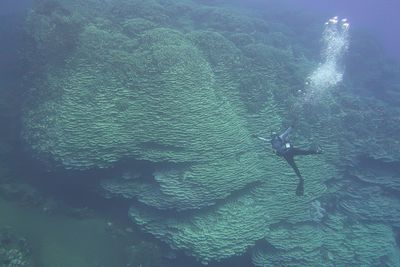


If you go down to the Mariana Islands today, you could be in for a big surprise. That is certainly the case for marine researchers from NOAA, as they’ve discovered the biggest Porites coral in the world.
Previously known only by locals, the behemoth of a coral structure resides in the Maug Islands in the Mariana archipelago. Fortunately, scientists got the opportunity to study the structure as part of a wider project called the 2025 National Coral Reef Monitoring Program.
“This coral was so big, we actually couldn’t easily measure it due to dive safety restrictions,” said Thomas Oliver, PhD, a chief scientist of NOAA’s National Coral Reef Monitoring Program, in a statement.
The survey results show the stony coral (Porites rus) covers 1,347 square meters (14,500 square feet) and is more than 31 meters (100 feet) across at the top. The bottom by comparison is much wider, being double that of the top at 62 meters (200 feet), coincidentally the same size as ESA’s Ariane 6 rocket.
This makes it the largest Porites coral ever found. It could also be one of the oldest; the corals grow outwards by roughly a centimeter a year, suggesting that the coral could be more than 2,050 years old.
“It is difficult to tell the true age of this coral because it doesn’t produce growth bands like other corals,” said Hannah Barkley, PhD, a chief scientist of NOAA’s National Coral Reef Monitoring Program. “We roughly estimate that Porites rus grows outward about a centimeter per year, so one could imagine that a colony of that size is pretty old.”
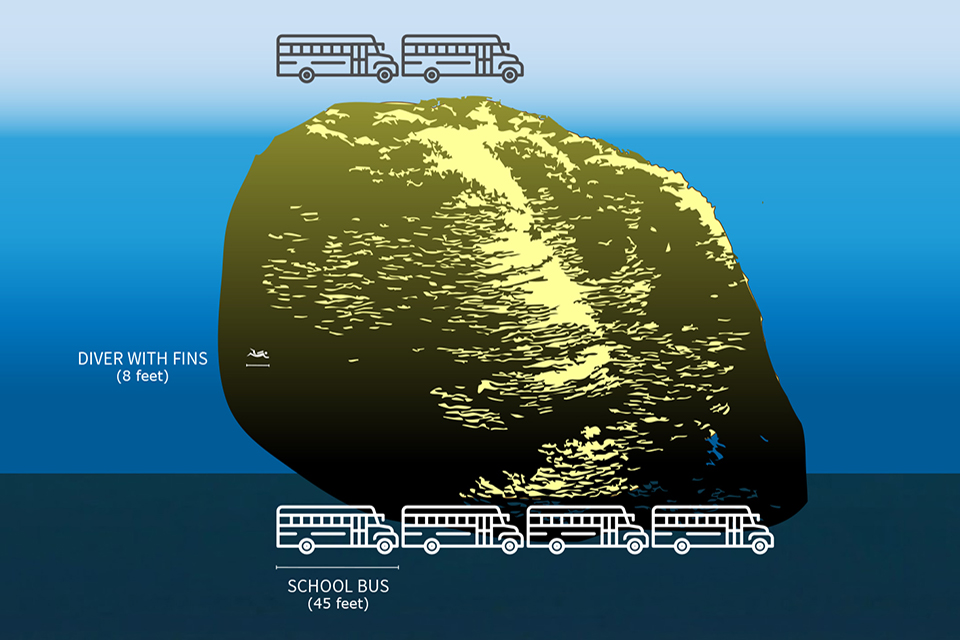
The coral itself sits in a pretty unique environment within the Mariana Trench Marine National Monument: a volcanic caldera. This area features a lot of carbon dioxide vents, which can create more acidic ocean conditions for those creatures living close to the edge. This can help scientists measure the effects of ocean acidification.
“It is remarkable to see both these extremes — a resilient and thriving mega coral, and a dead zone near the carbon dioxide vents — in the same area. Maug is truly such a special place,” said Barkley.
Recently, another giant coral colony was discovered off the coast of Australia. This Pavona clavus coral colony is estimated to be 111 meters long (366 feet) and covers an area of 3,973 square meters (40,000 square feet) and is thought to be the world's largest.