Nature
 PUBLISHED


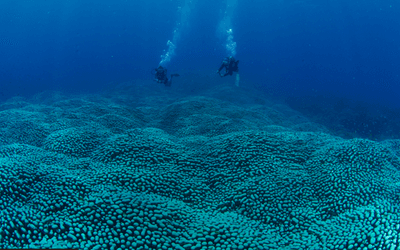


A mother-daughter team of citizen scientists has discovered a single coral colony on the Great Barrier Reef stretching more than 100 meters, making it the longest ever documented. The finding helps reveal the circumstances that favor coral resilience in light of the mass bleachings of recent years.
Coral reefs are made up of many individual colonies, usually from a wealth of different species, creating the diversity that allows them to host around a quarter of all marine species in a tiny fraction of the ocean’s volume. Sometimes, however, a single colony thrives, and it seems one has done so well that it has become the watery equivalent of Pando or the humongous fungus.
Sophie Kalkowski-Pope is Marine Operations Coordinator at Citizens of the Reef, an organization that helps volunteers document and protect the reef they love. Kalkowski-Pope and her mother, Jan Pope, were taking part in the Great Reef Census, which tracks the health of the Great Barrier Reef (GBR) off the coast of Queensland, Australia, which is the world’s largest coral reef system.
“I knew right from the minute we dropped in that it was something special,” said Kalkowski-Pope in a statement. “When I got in the water, I’d never seen coral growing like this before,” Pope said. “It looked like a meadow of coral. It just went on and on.”
The pair were not equipped with instruments designed to measure something this size, but used several approaches to gain an estimate of 111 meters (366 feet) and an area of 3,973 square meters (40,000 square feet). That’s a little longer, but a bit smaller in area, than the standard football pitch for the world game, although the fields used for Queensland’s preferred sport of rugby are somewhat larger. Lest anyone get carried away, the ovals for Australian rules football are 3-6 times the colony’s size. For those who prefer unconventional units, it’s as long as 25 giraffes or 182 corgis.
The size has since been confirmed using high-resolution imagery carried by boats. For comparison, a colony in the Solomon Islands that was hailed as the world’s largest in 2024 is a third the size. Shortly afterwards, that was trumped by a Bali behemoth, covering a similar area to the new discovery, but not as long.
The new discovery is a species of Pavona, like the one in the Solomons, but the Bali challenger is Galaxea astreata.
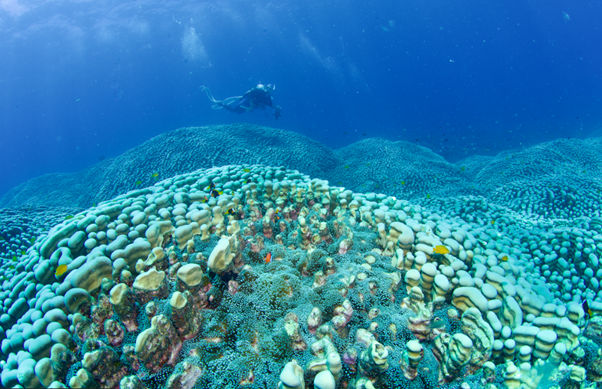
The new Australian colony has been kept secret to prevent over-tourism or even vandalism. You might think it would be difficult to hide something this size, but the GBR includes 2,900 reefs stretching a distance of 2,300 kilometers (1,400 miles).
That size is why scientists need volunteers to help with reef monitoring. “The Great Reef Census helps us to locate the most important sources of reef recovery, helping scientists and managers better target their protection,” said Prof. Pete Mumby of the University of Queensland. More than 100 boats, many provided by tourism operators, take part, along with hundreds of divers and snorklers, all under the guidance of scientists and traditional owners.
“The benefit of this kind of spatial data is that we can take measurements at very high resolution,” said Serena Mou of Queensland University of Technology. “It also means we can return in future months and years and make direct, one-to-one comparisons to understand how the coral changes over time.”
Citizens of the Reef CEO Andy Ridley told IFLScience the key to the colony’s success is probably that it is located in an area of exceptionally strong currents. “We had to dive it during the slack of the neap tide,” Ridley said. Even so, images reveal air bubbles flowing behind the divers because the current was so strong. “We’ve found that where current flow is higher, corals seem to be more resilient,” Ridley added.
The colony is on a reef in relatively deep waters, by GBR standards, of 7-12 meters (23-40 feet). Deep water reefs are also surviving the coral crisis better than their shallower counterparts because they are subject to less extreme temperatures in summer.
The final piece of the puzzle is that, according to Ridley there are no local stressors like over-fishing or nutrient runoff, which elsewhere are combining with global heating to put reefs in danger. However, Ridley added, “We did find a few crown-of-thorn starfish.” These seastars can consume and devestrate tropcial coral reefs.
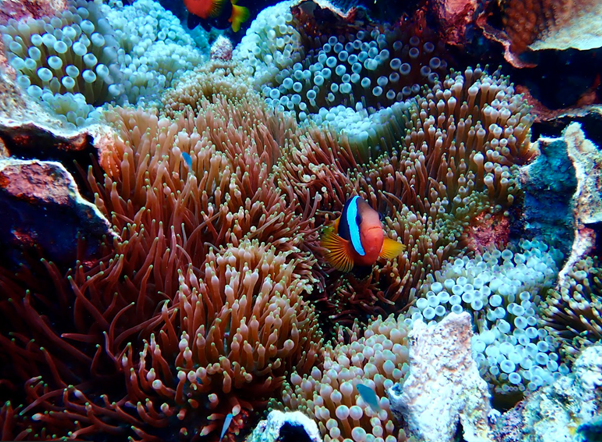
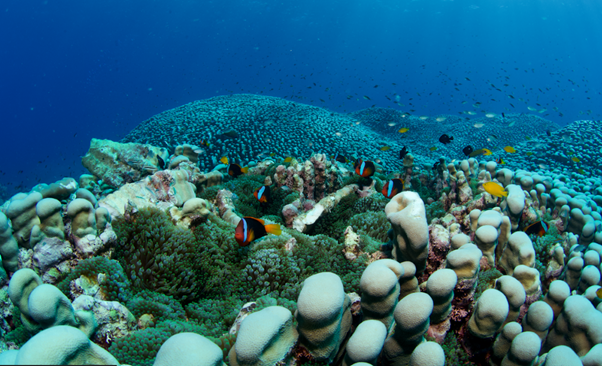
Monocultures are usually a sign of an unhealthy ecosystem, but Ridley told IFLScience that despite its size, the Pavona colony shares its reef with some plate coral and a boulder coral. More importantly, he noted, “It is sustaining a lot of species within its branches, providing a very healthy, diverse habitat.”
Ridley expressed frustration that reports on the state of the GBR either undersell the threats from climate change, which he called “beyond serious,” or treat the reef’s fate as sealed. Instead, he said the census reveals a much more nuanced picture, with some locations thriving, while the majority are stressed or dead. Globally, the situation for corals is even worse, but there is still hope for some, although Ridley expressed fears that “Actions are missing at the moment,” as international conflict takes attention away from better stewardship.

 1
1