Nature
 PUBLISHED


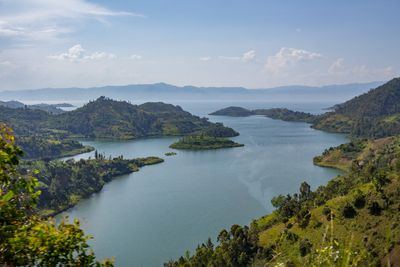


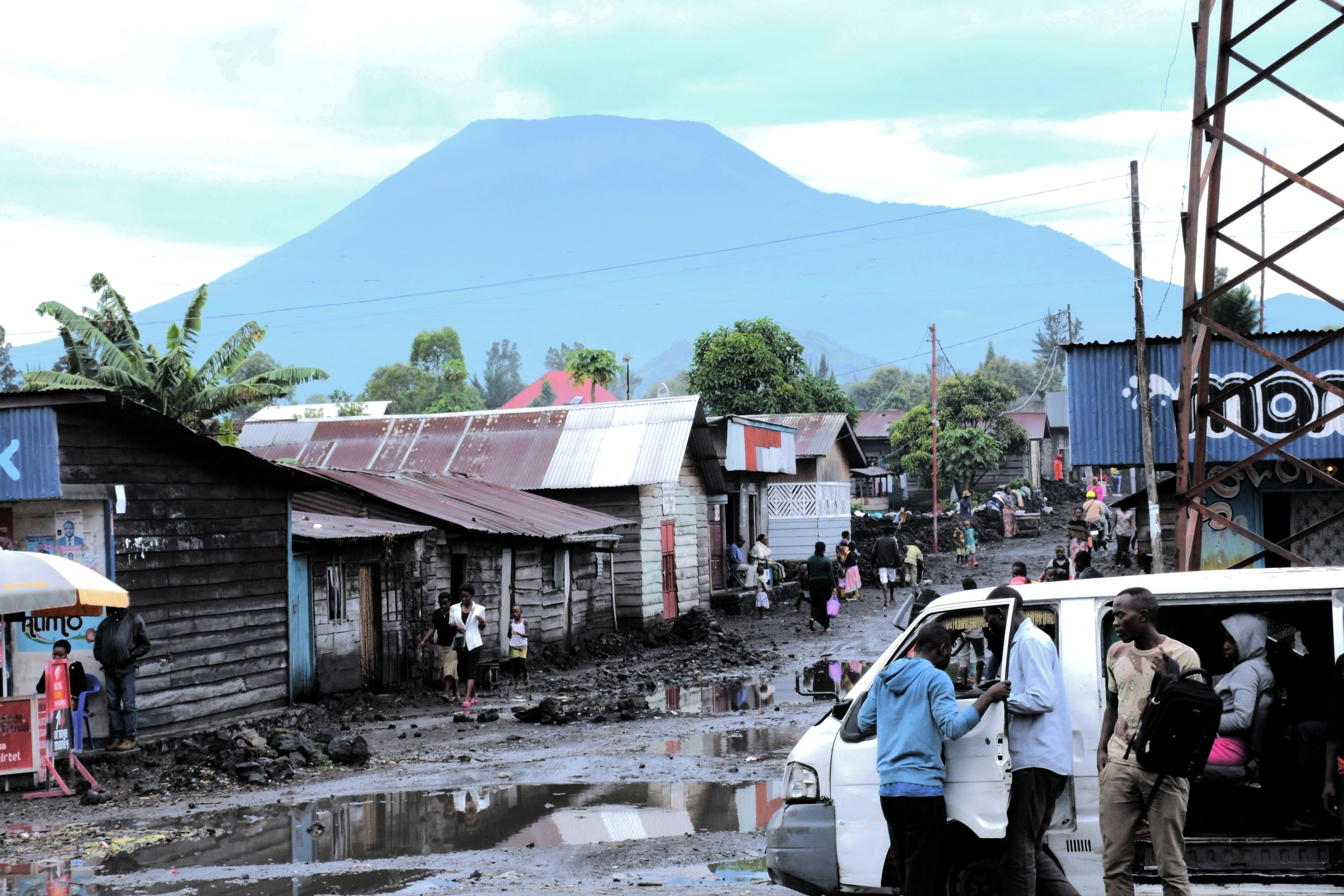
Goma, on the eastern border of the Democratic Republic of the Congo, is a bustling city of around 1.2 million people – most of them children. It sits on the banks of one of Africa’s Great Lakes, and the views are stunning; in the background, a looming misty mountain tops off the scenery with dramatic beauty. It’s always warm there. There are elephants. It should be nice.
Instead, it’s a city filled with existential dread. For decades, it’s been at the center of a series of wars and conflicts between primarily Congolese and Rwandan forces, seeing multiple atrocities and humanitarian crises as a result – indeed, a large chunk, perhaps the majority, of its millions-strong population are displaced people or refugees.
But even if all that were to end tomorrow, Goma’s problems still wouldn’t be over. That beautiful mountain? It’s Mount Nyiragongo: an active volcano, and one that’s erupted around half a dozen times in the last century alone, causing destruction on a sometimes massive scale within the city. And that lake?
That’s Lake Kivu.
Why we fear Lake Kivu
In August of 1986, a tragedy struck at Cameroon’s Lake Nyos. It erupted, for want of a better word: water that had been saturated with carbon dioxide at the bottom of the lake was disturbed, causing it to rise and become super-saturated in a self-reinforcing system until, eventually, all the gas was expelled in one mighty – and deadly – belch.
Close to 1,800 people asphyxiated in their sleep that night, along with countless animals and birds – a tragedy by anyone’s measure. But it could have been much worse.
“As bad as the Nyos explosion was, it should be noted that carbon dioxide, while lethal, is not combustible,” wrote John Richard Saylor, professor of mechanical engineering at Clemson University, in his 2022 book Lakes: Their Birth, Life, and Death. “The same cannot be said for Lake Kivu”.
As in Nyos, gas from underground tectonic activity is released into the water of Lake Kivu, and, also as with Nyos, that gas is – mostly – held safely at the bottom of the lake. But unlike Nyos, that gas isn’t just carbon dioxide – it’s also methane, the natural gas that we use to ignite our stoves and furnaces.
“Exactly what the consequences and risks this has for the people who live around Kivu is unclear,” Saylor wrote. “But one should probably take note of two facts: natural gas burns, and Lake Kivu is more than a thousand times larger than Lake Nyos.”
It sounds like the perfect recipe for a disaster on an unimaginable scale: a vast amount of explosive gas, active volcanic and tectonic activity, and a large population of people in between. So, here’s the question: how worried should we be?
Wild water
One day, Lake Kivu will no longer exist. Not for the reason that most lakes disappear – because they fill with sediment or evaporate away – but because it will be subsumed by the giant ocean that will by that point separate East and West Africa.
All of which is to say: Lake Kivu doesn’t sit in the most stable of places, tectonically speaking. The ground underneath is ripping itself apart, releasing molten rocks and gases from deep within the Earth as it does so.
And of course, some of those gases end up in the water. “Kivu has a complicated vertical structure,” Sergei Katsev, a limnologist at University of Minnesota Duluth, told National Geographic back in 2024. “The top [60 meters/200 feet] or so mix regularly,” he explained, but past that depth, it’s highly stratified. Look at a cross-section of the water, and you can see a clear delineation between the cooler, fresher water at the top and the warmer, saltier water below.
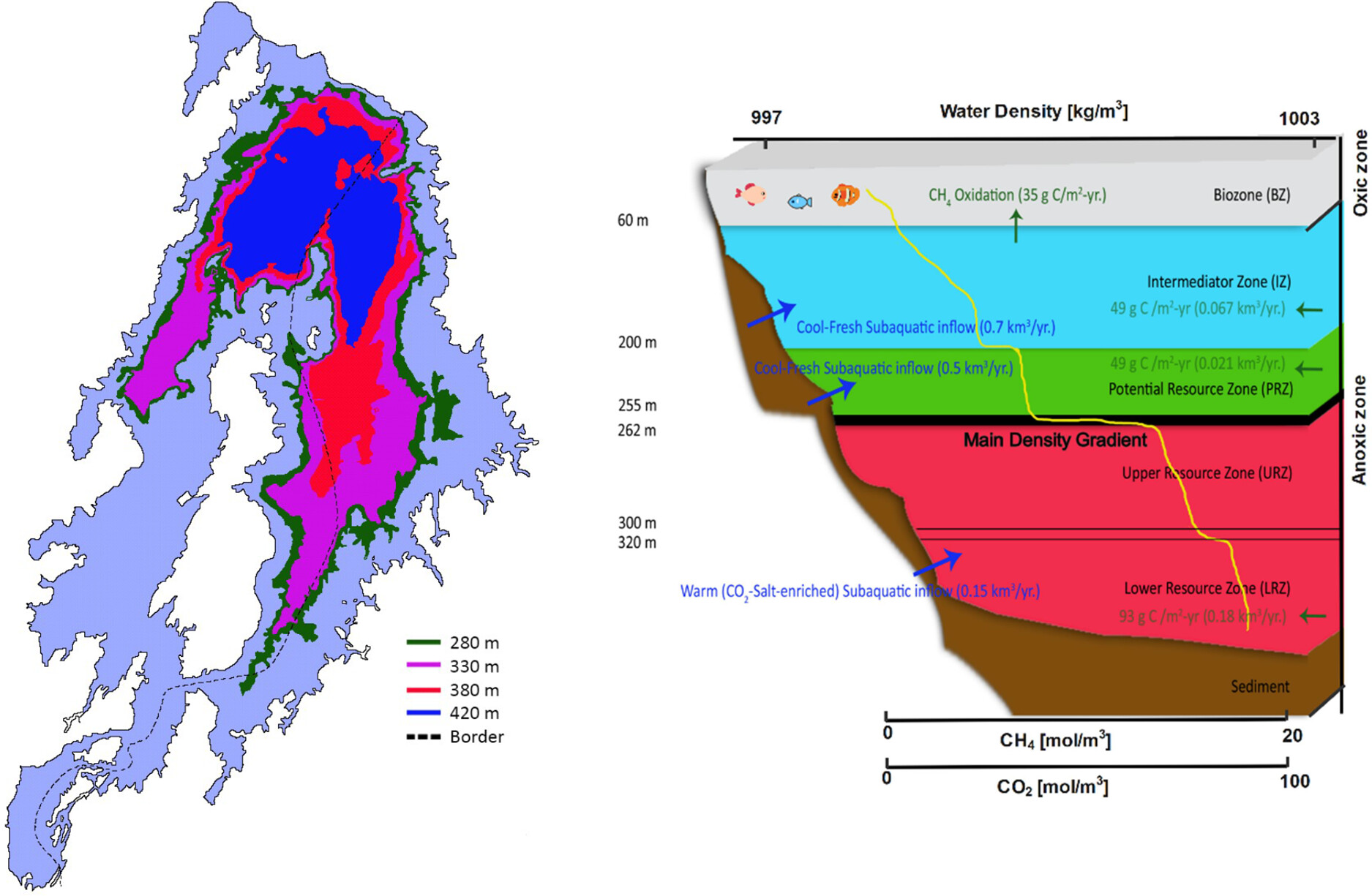
Within Lake Kivu you can find some 300 cubic kilometers (72 cubic miles) of dissolved carbon dioxide – multiple orders of magnitude more than was released from Nyos back in 1986 – along with 60 cubic kilometers (14 cubic miles) of methane. Normally, that’s not a problem: the layers are stable and separate.
If they’re disturbed, however – perhaps by “an earthquake or a large lava intrusion,” Katsev suggested, presumably side-eyeing Mount Nyiragongo as he did so – the gases might be knocked upward, into lower pressures that can no longer keep them dissolved in the water. The result: an eruption that could release an extra five percent of CO2 emissions globally, all in one highly toxic burp.
“[The lake] would release the equivalent of 2-6 gigatonnes of carbon into the atmosphere in a day,” said Philip Morkel, an engineer and founder of Hydragas Energy, a Canadian company seeking funding for a project to extract and exploit methane from the lake for electricity. “That erupted gas would hang over the lake in a foggy cloud for days to weeks.”
“The gas would be extremely toxic,” Morkel added. As with Nyos: “If anyone were in that cloud, it would take a minute to kill them.”
Explosive potential
Carbon dioxide may be a killer, but it’s a silent one. The methane, on the other hand – well, that could be disastrous.
“The methane would not spontaneously cause an explosion on the surface,” explained Robert Hecky, a professor of lake ecology at the University of Minnesota, to the BBC. But “there are numerous possible ignition sources above and around the lake.”
And the methane is much closer to escaping than the carbon. It’s less soluble, and so the water can hold less: “It’s the methane that’s the problem,” Alfred Johny Wüest, a lake physicist at the Swiss Federal Institute of Aquatic Science and Technology (EAWAG) in Kastanienbaum, told Nature in 2021. “It’s not like Lake Nyos.”
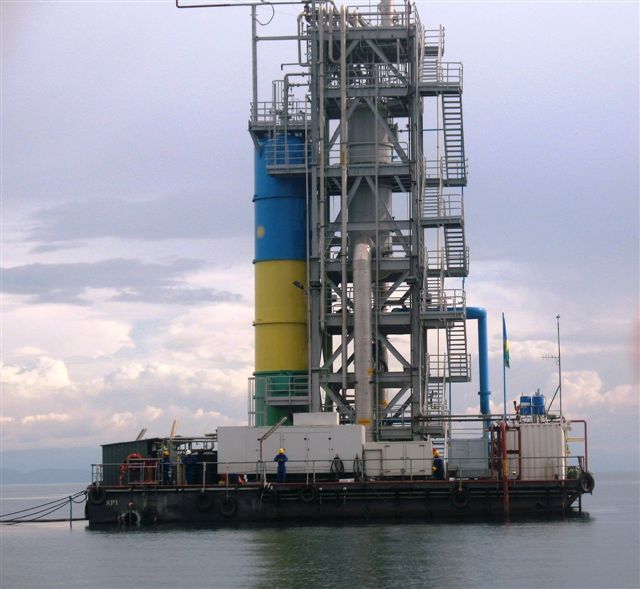
For some experts, including Wüest, the answer is to extract that methane, ASAP. It’s taking up more water than the lake can afford to give; remove it, and you buy the locals decades more time to deal with the carbon dioxide. And there’s another potential benefit: “[You could] take this gas, ship it via pipeline onshore and burn it the way you would burn fossil fuels to generate electricity,” Katsev told Knowable Magazine in 2020.
For the local Rwandan and Congolese communities, such a move could be game-changing – which is why, in recent years, they’ve been doing exactly that: removing water from deep in the lake, harvesting the methane at the surface, and returning the degassed water to the lake. The main company doing this, British-owned KivuWatt, was adding 26 MW of energy to Rwanda’s grid using this method back in 2024 – already increasing the country’s total energy capacity by almost 10 percent – and it aims to increase that to 100 MW in the future.
It might seem like a perfect solution to the looming threat of disaster at Lake Kivu – but not all experts are convinced. Partly, that’s because removing the methane at current rates simply won’t stop disaster if one of the many potential geological events should strike. Partly, though, it’s the Jurassic Park argument: that even if we can extract the gas, maybe we’d be foolish to actually do so.
“It’s a compromise of safety versus commercial exploitation in the long term,” Katsev told National Geographic. “If you return the water deep in the lake, you dilute your resource zone for future years. However, if you dump it higher up” – as KivuWatt does – “the water generates a plume as it sinks downward through the density layer, causing the water to mix vertically.”
And, he pointed out, “The risk of limnic eruption is linked to this vertical movement.”
Future proof
Despite Katsev’s and other scientists’ warnings, methane extraction at Lake Kivu now seems unstoppable. Whether or not it leads to disaster, only time will tell.
That said, Lake Kivu is something of a timebomb even without its more flammable ingredient. “You have a gas-rich lake sitting next to a volcano; you have a potential for many triggers,” Hecky told Nature.
And eventually, something’s going to happen regardless. As Lake Nyos taught us: water may be able to hold a lot of carbon dioxide, but it can’t keep absorbing forever. “When the lake reaches 100 percent saturation […] it will erupt spontaneously,” warned Morkel. “And it is currently somewhere over 60 percent.”
“It’s like a boiling pot of water,” he said. “It looks quiet – until it starts to bubble.”