


 Technology
 PUBLISHED


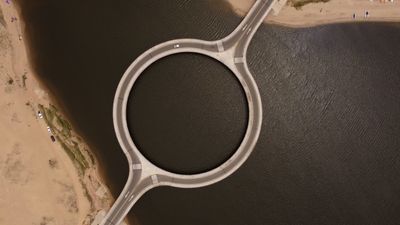


Bridges can be long, and bridges can be high, but did you know that they can also be circular? At least, that’s the case for Laguna Garzón Bridge in Uruguay, an all-round great example of why circular bridges should be more of a thing.
Though this bridge is circular, this isn’t a roundabout we’re talking about – it has two semi-circular halves, each with a one-way road and held up by round concrete pillars. Its purpose was to allow drivers to cross the lagoon smoothly; previously, they had to do so using motorized rafts.
The bridge was designed by Rafael Viñoly Architects, the same firm that’s responsible for a number of well-known buildings throughout the world, including the super-tall 432 Park Avenue in New York, Japan National Stadium in Tokyo, and 20 Fenchurch Street, better known as London’s infamous “Walkie Talkie”.
As reported by Dezeen, the lagoon bridge cost $10 million to build, and was constructed from more than 450 tons of formed steel, 40 kilometers (25 miles) of post tensioned cables and 3,500 cubic meters (123,600 cubic feet) of concrete. It was completed in 2015, after a year of work.
At first glance, it’d be easy to dismiss the bridge’s shape as unnecessary – but the architectural firm designed it with some very specific outcomes in mind.
First and foremost, Garzón Lagoon is one of 22 places in Uruguay designated as an Important Bird and Biodiversity Area, home to a wealth of bird species, including the Chilean flamingo and several plover species, endangered amphibians like the Darwin’s toad, and the largest remains of the country’s otherwise fragmented coastal psammophilous forest and scrub.
As such, it was important to create a bridge that would disturb the surrounding ecosystem, water and all, as little as possible.
“By separating the circular bridge’s two roadways, the design reduces the time that any given spot on the water surface is continuously shaded as the sun moves across the sky and minimizes the contiguous area impacted by the shade, which improves light penetration and dispersal across the water column,” Rafael Viñoly Architects explains on its website.
It was also designed to get people to slow down, in more ways than one.
“The structure’s fairly tight turning radius also forces motor vehicles to slow significantly while crossing, and encourages drivers to take in the natural beauty of the area,” said the architectural firm.
You don’t have to drive to enjoy the landscape either. Pedestrian walkways on either side of the split traffic lanes give access to the bridge’s central opening and its perimeter,” the architectural firm explains, “where visitors can sit, fish, and take in the views.”
As bridges go, that sounds pretty dreamy. Definitely more relaxing than driving across the longest bridge in the US, anyway.


 3
3