Technology
 PUBLISHED


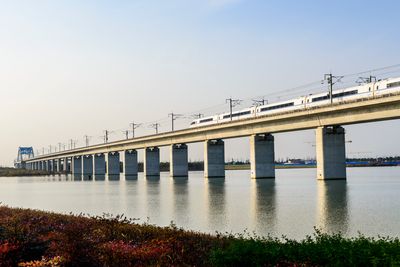


Bridges come in all shapes and sizes: from the world’s longest suspension bridge that connects Europe and Asia, to India’s ingenious bridges made of living roots. However, the Danyang-Kunshan Grand Bridge in China holds not one, but two titles for both the longest and second-longest bridge in the world.
Forming part of the Beijing-Shanghai High-Speed Railway, the Danyang-Kunshan Grand Bridge in China connects Shanghai and Nanjing to form the world’s longest bridge. This impressive feat of engineering stretches for a whopping 164.8 kilometers (102.4 miles) and traverses rice paddies, lakes, rivers, and even cities.
Running parallel to the Yangtze River from its mouth in Shanghai, the bridge has an average height of 100 meters (328 feet) – but, as it’s designed to allow ships to pass underneath it, some areas of the bridge have a clearance of 150 meters (492 feet).
Due to its length and the differences in terrain beneath the bridge, it is technically both a viaduct and a cable-stayed bridge in different sections. Viaducts are characterized as bridges that are supported by a series of towers or arches beneath the bridge, while cable-stayed bridges are supported by diagonal, tension-straight cables that run from towers above the bridge.
The Danyang–Kunshan Grand Bridge is so long that a sub-section of the bridge, known as the Langfang–Qingxian viaduct, can even be considered the second longest bridge in the world with a length of 114 kilometers (70.8 miles).
The completion of the Danyang–Kunshan Grand Bridge in 2011, after just four short years of construction, has transformed railway travel in the area by reducing a 4-hour 30-minute journey from Nigbo to Jiaxing down to just 2 hours by train.
Costing a staggering $8.5 billion to build – that’s $51 million per kilometer – the entire bridge is made up of around hundreds of thousands of tonnes of steel and is supported by roughly 11,500 concrete pillars. One section of the bridge alone uses 2,000 pillars to cross Yangcheng Lake in Suzhou.
Despite the comparatively speedy construction, the bridge has been built to withstand a host of natural disasters that have been known to affect the area such as earthquakes and typhoons, as well as being equipped to take on a direct 300,000-tonne hit from a navy vessel. The bridge's estimated lifespan is over 100 years.
Not only has the bridge improved the function of public transport for the region, but it has also become a tourist attraction in its own right, with people travelling from around to world to experience the picturesque views from this surprisingly short train ride.