Technology
 PUBLISHED





Give five musicians the same piece of music and you’ll get five different performances. Artists leave unique fingerprints behind in their work, marking it out as their own interpretation. To all but a highly trained ear, these can be invisible – but scientists just trained computers to find them.
The team, from the University of Cambridge, trained machine learning models on 84 hours of recordings of improvisations from 20 legendary jazz pianists. Lucky old computers, we say.
The music included 1,629 solo and ensemble performances from greats like Bill Evans, Oscar Peterson, and Thelonious Monk.
Virtuosic musicians like these show differences in their brains compared with non-musical people. Intriguing research has also previously suggested that jazz musicians’ brains look different even from those of classical musicians.
But jazz music itself, in all its complexity, has been more difficult to study scientifically.
“Computational analysis of jazz has historically been difficult,” the team writes in their paper. “Most jazz performances only exist as audio recordings, and models trained directly on audio are typically hard for humans to interpret.”
To facilitate the analysis, the recordings were transcribed into MIDI “piano roll” files, a standard digital format used for composing, orchestrating, and editing. It shows when notes are being played and at what pitch, a visual representation of an audio track.
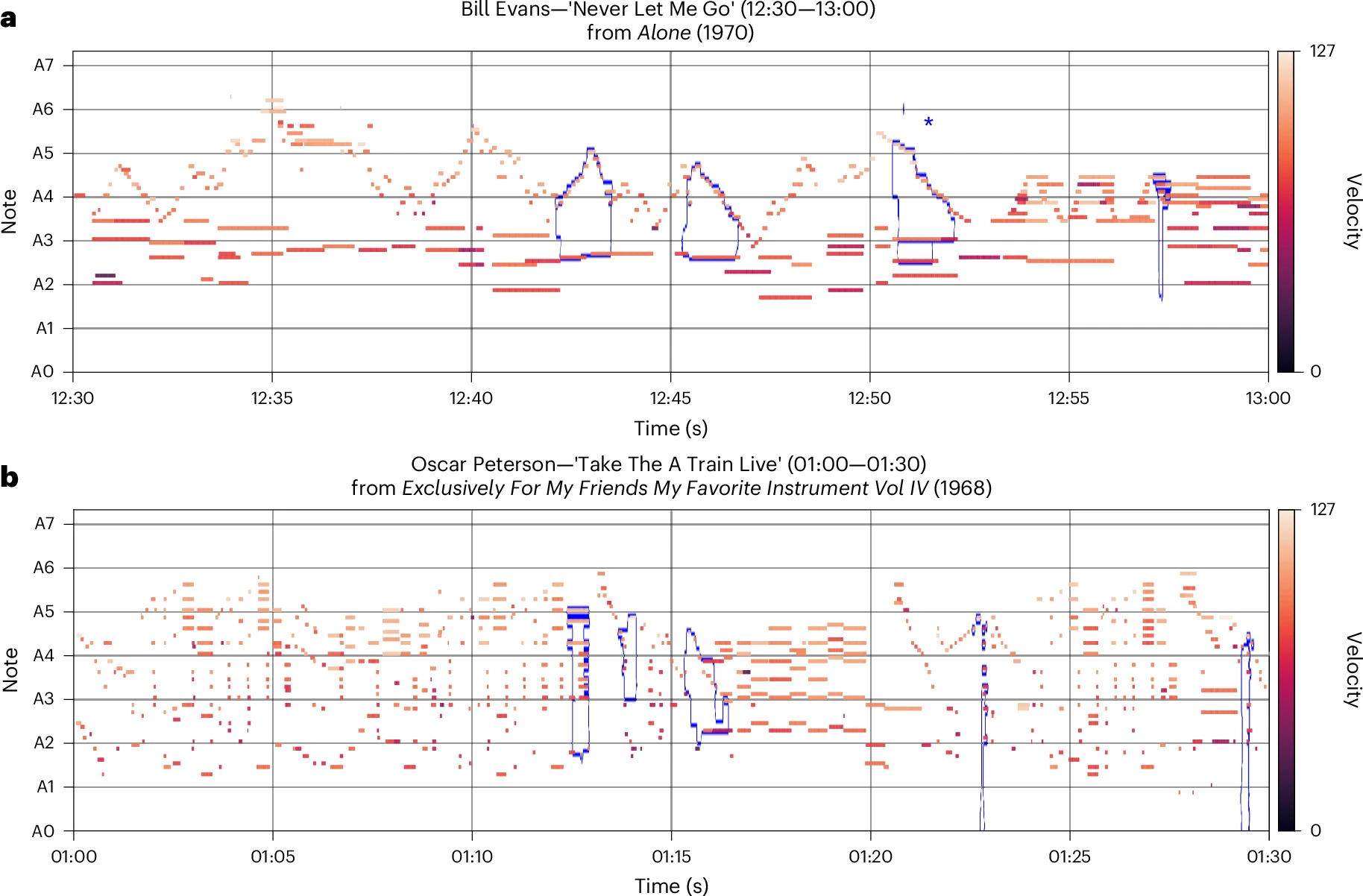
From this, the team was hoping to answer questions around what made different performers’ recordings uniquely “theirs”, and how different performers’ fingerprints might compare to each other’s.
“What distinguishes one artist from another?” they write. “This question lies at the heart of arts scholarship.”
It’s helpful, for example, in identifying the artist behind an unattributed work, or distinguishing forged art from the real thing. It helps students learn the idiosyncrasies of important figures in their field of study. People have been challenging themselves to spot the “fingerprints” in famous music for eons, and now the computers are having a go.
Scales and arpeggios
The analysis focused on the four musical domains of melody, harmony, rhythm, and dynamics.
The best of the models the team tried was able to identify the correct performer for a recording with 94.4 percent accuracy.
One example of a fingerprint was found in many of the recordings by Bill Evans: a descending major or minor seventh arpeggio. This appeared 128 times in his recordings, and only around 30 times in other people’s, and has previously been identified by scholars as a signature of Evans’s improvisations.
From the results, the team could also discern musical motifs that artists tend not to use. For instance, Oscar Peterson and Junior Mance frequently include octave tremolos in their playing – quickly alternating between one note and the note a full octave above or below it – whereas these appeared much less often in Evans’s work.
There’s a free web app where you can explore all the study results in more detail for yourself.
Using the computers for this analysis, the authors explain, “allows much larger datasets to be processed” than even a highly trained and overworked human could manage, as well as offering “a level of statistical rigour that is unobtainable with manual approaches.”
“This work […] unlocks several exciting avenues for further research,” they conclude.
Suggestions include expanding knowledge of the work of historically underrepresented or under-researched musicians, and comparing musicians from the same geographical area, time period, or with similar cultural inspirations.
We at IFLScience always enjoy it when science and music collide. Some days it’s AI jazz appreciation… some days it’s cicadas playing Pachelbel’s Canon. You never can tell.
The study is published in Nature Machine Intelligence.