Technology
 PUBLISHED





Anthropic's Claude AI has just discovered a previously unknown enzyme system that bears a striking resemblance to the gene-editing technology CRISPR, according to the firm. The company said its AI system achieved this by trawling through billions of genetic sequences with minimal input from human supervisors.
In its announcement of the finding, however, Anthropic said it currently does not know how the new system works in nature or whether it could be adapted for practical applications, which is what happened with CRISPR.
Despite this, the discovery remains significant if only because it is the first result from Anthropic's new life sciences laboratory, whose existence is a sign that AI firms are pushing for more involvement in the process of scientific discovery.
In a preprint paper describing the work, Anthropic researchers describe how they set their agents to analyze a database of DNA sequences relating to 1.9 billion protein clusters - a dataset far too large for humans to manually sift through - in search of new enzyme systems.
Rather than asking Claude to find a specific genetic sequence in this haystack, Anthropic said supervisors gave only a broad prompt and allowed AI agents to make their own decisions regarding which sequences to take an interest in and analyze in depth.
“Awareness of anomaly is proposed to be at the start of scientific discovery, and an anomaly exists only against an expectation,” write a team of Anthropic researchers in the paper, which has yet to be peer-reviewed. “In earlier attempts to automate scientific discovery, both the expectation and the judgment of novelty were supplied by human experts."
In other words, the researchers didn't give the agent any specific instruction or expectations; instead, it "noticed" the unusual DNA sequence all by itself. Or, as the researchers put it: “the agents supplied both the expectation, drawn from their own knowledge rather than their task, and the judgment that the atypical observations merited further pursuit.”
An abundance of agents
A total of 950 agents running Anthropic's highest-tier Mythos model spent 21 hours analyzing the enormous database, at which point one agent reported that it had found something "spectacular." Within the genome of jumbo-phages - which are large viruses that infect bacteria - the AI noted a never-before-seen configuration of DNA around an enzyme that converts RNA into DNA, called a reverse transcriptase (RT).
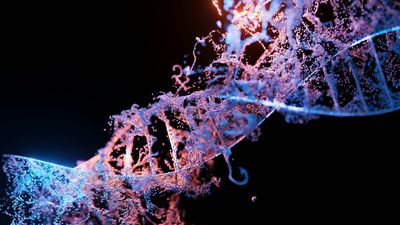
Specifically, the RT was surrounded by a peculiar array of DNA sequences as well as another gene. The researchers note that this arrangement is similar to CRISPR, a natural bacterial defense mechanism that is now used as a gene-editing technology. The researchers have named the new system array-associated reverse transcriptase (ART).
Acting as a kind of bacterial immune system, CRISPR works by allowing bacteria to capture sections of DNA from invading viruses and convert them into RNA molecules. These act like targeting systems to guide an enzyme called Cas9 towards the virus and destroy it.
Like CRISPR, ART consists of a DNA array accompanied by an enzyme. However, at this stage it is unclear how the two work together or if the system functions in the same way as CRISPR. There are many similar bacterial defense mechanisms against viruses, and so far CRISPR is the only one found to be pliable enough to use practically for targeted gene editing.
"CRISPR’s key feature is that it can be programmed to target and edit specific DNA sequences," writes Dr Dmitri Perrin at Queensland University of Technology, in the Conversation. "It is not known whether the same is true of ART. At this point in time, we can say that ART is CRISPR-like in its architecture, but there is no evidence that it is CRISPR-like in its function."
According to Anthropic, work to identify the function of ART is ongoing, and while it’s far too early to say whether this newly discovered system might be useful as a gene-editing technology, the company emphasized that an AI agent was able to identify it all by itself, which can be seen as a milestone and potentially a taste of things to come.
“We believe that this acceleration will come from establishing a new way of doing biology research, in which agents collaborate with humans in every step of the process,” it said.
The study is currently available as a preprint.