Technology
 PUBLISHED



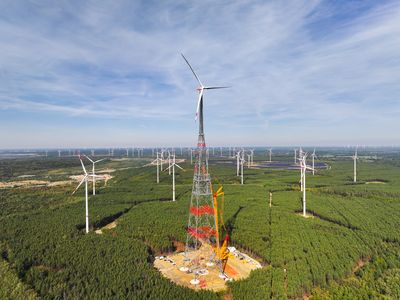


Tilt your head up high if you're driving down the autobahn between Berlin and Dresden: the world’s tallest wind turbine has been raised, standing at a soaring height of 365 meters (1,197 feet).
The towering turbine is located in Schipkau in a part of eastern Germany once associated with coal mining and smoggy power plants. It's another indication that Germany is pushing for more renewable energy, as well as greater energy independence in the wake of global conflicts.
A feat of design and engineering
The high-altitude wind turbine reached the final stage of construction in September 2026 after two years of hard work.
GICON, the engineering company behind the feat, hopes to have the turbine officially commissioned by the end of the year. Once up and running, it will first operate at a pilot level of around 3.8 megawatts, although the team aims to eventually reach outputs of more than 7 megawatts.
The design is essentially a wind turbine rotor perched atop a very tall metal tower. This extra altitude allows the turbine to pick up stronger and more consistent streams of wind, allowing it to harvest roughly twice the energy of a conventional turbine with the same-sized rotor.
Building the second-tallest structure in Germany
The wind turbine is the second-tallest structure in Germany, only narrowly beaten by the Fernsehturm Berlin, the 368-meter (1,207-foot) TV tower built during the Cold War, when the country and its capital were still divided.
By no coincidence, the construction of the high-altitude wind turbine was made possible thanks to the work of German engineer Horst Bendix, whose ideas helped to construct the Berlin TV Tower in the 1960s.
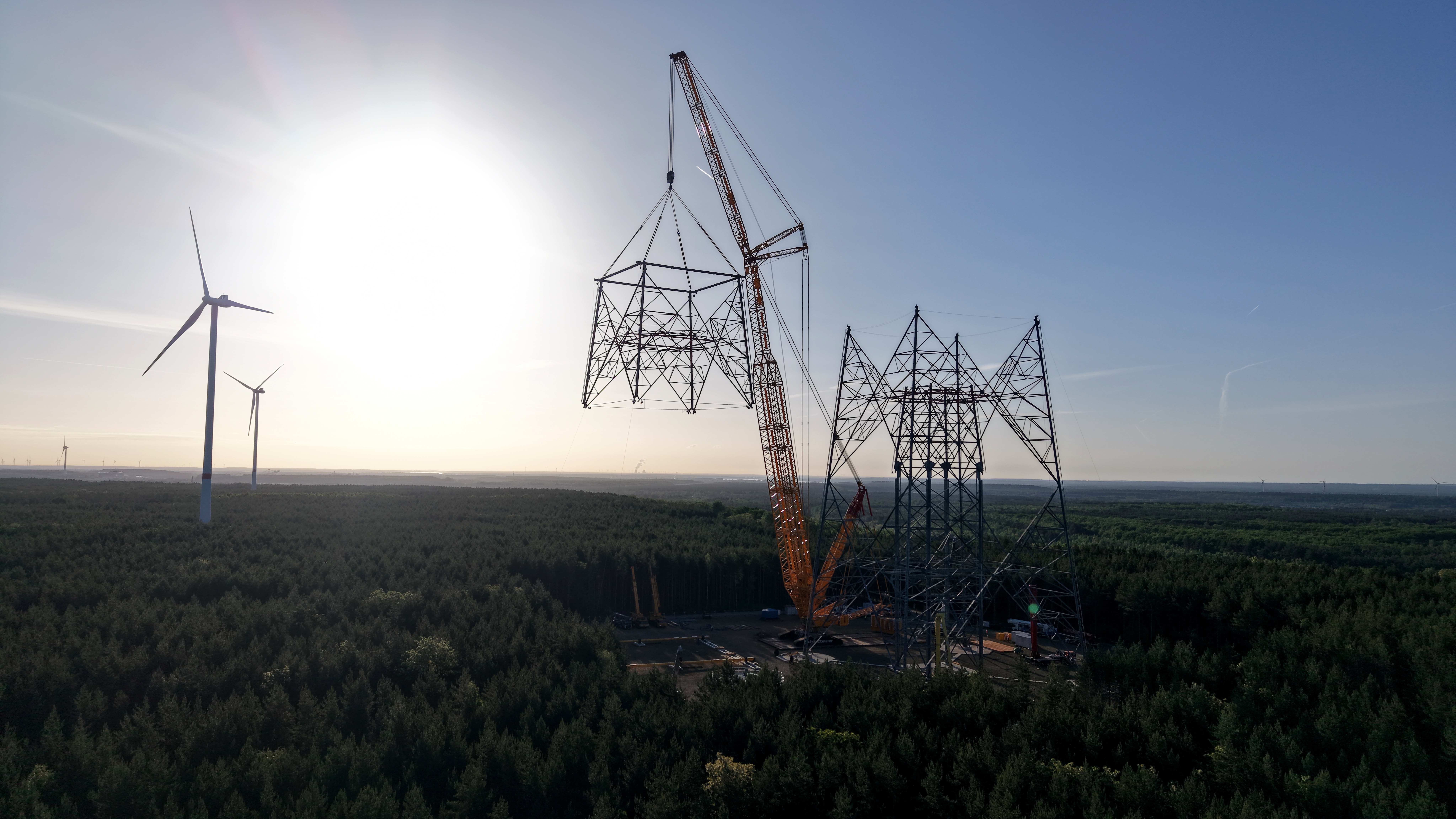
The biggest difficulty the engineers had to contend with was raising the heavy turbine and rotor 300 meters (984 feet) into the air. This is far too high for conventional cranes to hoist such a weight.
So, to solve the problem, an extremely strong, reinforced lattice structure was built at the base of the tower. Once the rest of the tower had been built on top, this allowed the central rotor to be hoisted through the middle and adjusted into position.
Construction still hasn't been totally straightforward. In late 2025, engineers ran into trouble when they discovered a problem with some of the steel components supplied by a subcontractor. The setback briefly halted progress, but work got back on track in early 2026 once replacement parts arrived.
“365 meters – this is an overwhelming moment for our entire team. What was long a challenging idea and then an equally challenging construction project now stands as a globally unique facility in Schipkau,” Professor Jochen Großmann, founder and CEO of GICON, said in a statement.
“This world record belongs to everyone who contributed with their knowledge, dedication, and perseverance – on the construction site and in the many teams behind the project. We at GICON are extremely proud of this,” he added.
This is just the beginning, though. GICON believes its engineering technology could see up to 4,000 high-altitude wind turbines becoming retrofitted into existing wind farms across Germany.