Technology
 PUBLISHED
 2
2


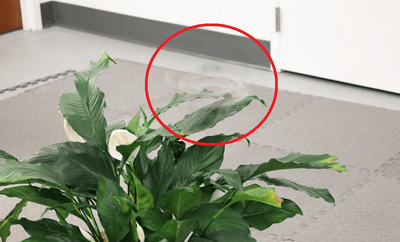


What if the best way to hide a drone wasn't camouflage or fancy optical tricks, but spinning really, really rapidly? That's the idea behind "Phantom Twist," a new gadget developed by engineers at Northwestern University that can blur itself into near-invisibility.
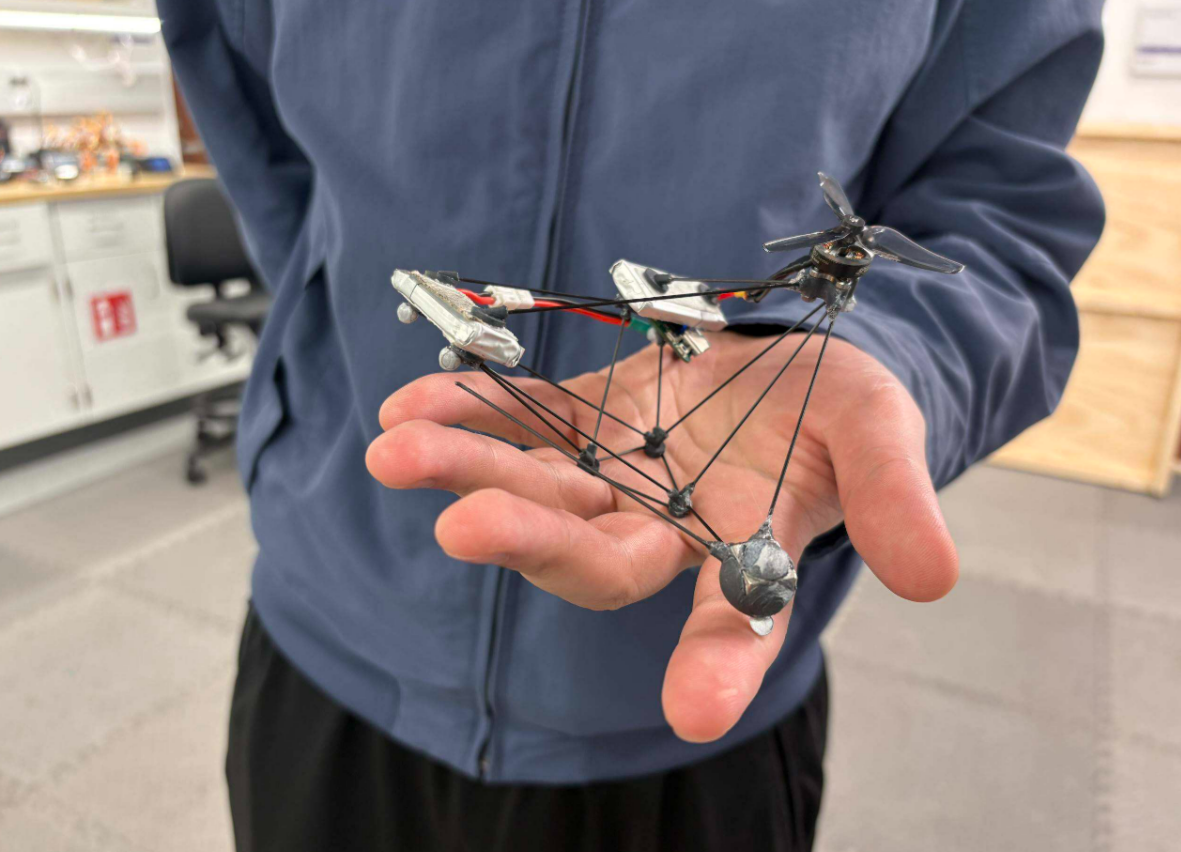
The handheld drone consists of a simple, wiry frame and a single propeller that lets it rotate up to 25 times per second, too fast for the human eye to perceive clearly.
As the video below shows, it doesn't disappear entirely like it's been covered in an invisibility cloak, but extreme motion blur reduces it to a fuzzy smudge that blends into the background surprisingly well.
“The human eye takes time to accumulate signals, roughly analogous to the exposure time of a camera,” Emma Alexander, an assistant professor of computer science at Northwestern's McCormick School of Engineering, said in a statement.
“When an object spins quickly, we perceive it as blurring out and losing distinct features. Because this new drone is almost entirely transparent, its few opaque components are visually averaged with the background for an overall appearance of a slight haze,” added Alexander, who is also an expert in computer vision.
If you think the drone's design looks a little strange, that’s because it’s the work of artificial intelligence (AI), a method that Northwestern has previously toyed with. Using computer simulations, the team emulates the process of natural selection, weeding out the least effective designs, until only the best one is left. Then they build it.
The researchers began by using a computational model to generate roughly 20,000 possible drone configurations capable of stable flight. AI-driven optimization algorithms then repeatedly rearranged the major components – including a motor, propeller, circuit board, counterweight, and batteries – in search of the best layout.
The strongest candidates were fed into a simulation that approximates human vision to see how noticeable each design actually appeared. After a further round of optimization, the team settled on a final design and created it in the real world.
“The design process was fully automated. Then, when we were confident that a drone met all our criteria, we built it,” explained Michael Rubenstein, an Associate Professor of Computer Science and Mechanical Engineering at Northwestern who led the work.
“Most efforts to hide drones focus on making them look like their surroundings. Instead, we asked whether we could design the drone itself around the way humans perceive motion. This idea of low visibility through persistent motion is something few people have explored,” he added.
The researchers suggest such a drone could be used to monitor wildlife, survey environments, and inspect infrastructure with minimal visual disruption. It could, of course, just as easily be turned toward covert surveillance or military use (not that the researchers proposed anything of the sort).
The project was presented at the conference Robotics: Science and Systems 2026 on July 16 in Sydney, Australia.