Technology
 PUBLISHED
 8
8


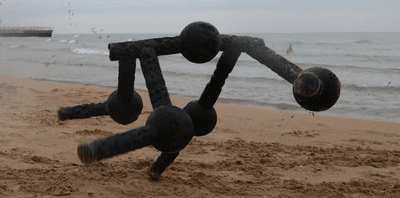


Humans didn't design these robots; they were “evolved” inside a computer. The results are strange, wildly flipping spider-like machines – and that's exactly what the researchers were hoping for.
If you ask a person to draw a robot, they will almost certainly create something that looks like it was borrowed from the natural world: a human athlete, a waddling dog, a springing kangaroo, or a crawling spider. Even a creative robotist will address the problem with a limited selection of pre-conceived ideas. But if you hand the same task to a computer simulation driven by natural selection, the results can be very, very different.
In a new study, researchers at Northwestern University began using an AI-driven program that algorithmically mimics natural selection. The team plugged in thousands of simple robot designs, each built on a modular approach involving little more than stubby limbs, a motor, a battery, and a computer brain.
By mixing and matching these modules in different combinations, the algorithm generated new body types. Depending on the robot's overall body plan, the same modular components could become legs, a spine, or a tail. It then simulated each design, keeping the best performers and discarding the less effective over and over again, much like the way natural selection works in the real world.
“We simulated the Darwinian process of mutation and selection within a virtual, physical environment. This is survival of the fittest – accelerated by computers and made real by athletic modular building blocks,” Sam Kriegman, an assistant professor of computer science, chemical and biological engineering, and mechanical engineering at Northwestern University, said in a statement.
“Evolution can reveal new designs that are different from or even beyond what humans were previously capable of imagining. So, we really wanted to study how and why it works. The best way – or at least the most fun way – is to evolve structures in realistic conditions,” he added.
The team then built the “legged metamachines” that emerged from this AI-driven process. As you can see from the images and video, the AI churned out strange new “species” of machines that few human engineers would even dream of.
“These are the first robots to set foot outdoors after evolving inside of a computer,” added Kriegman, who led the study. “They are rapidly assembled and then quite literally hit the ground running. They can move freely in the wild and easily recover from major injuries that would be fatal to every other wild robot. If flipped upside down, they instinctively bring themselves upright and continue their journey. They can survive being chopped in half or cut up into many pieces. When separated, every module within the metamachine can become an individual agent.”
The robots are anything but familiar – in fact, they look awkward, freakish, and a bit reckless in their movements. However, they are well-adapted to the challenge at hand. A single point of failure won't stop these machines. Where conventional robots falter if they lose a part, these “metamachines” are built to adapt and carry on. If they lose a leg, for instance, the remaining modules reorganize and press forward. Even the severed leg doesn't just give up. If a limb breaks off, it’s able to move by itself and find its way back home, ready to rejoin the whole.
“It can sense its surroundings, move from place to place, compute, and learn,” Kriegman said. “Metamachines can be rapidly assembled, repaired, redesigned, and recombined. Once assembled, they immediately move themselves across a wide array of unstructured environments.”
The researchers believe this could be the future of robotics. Instead of rigid, pre-designed robots that easily falter when something goes wrong, these modular metamachines adapt, recover, and evolve, more like squishy living organisms than mechanical machines.
The study is published in the Proceedings of the National Academy of Sciences.