Technology
 PUBLISHED




Modern computer gaming arguably goes back to 1958 CE, when Brookhaven lab technician Bob Dvorak spent a few hours putting together the game Tennis for Two – a tennis sim played with a custom controller, and the resulting game being displayed on an oscilloscope.
True online gaming (played over an Internet connection or network) came a few decades later, with Maze War in 1973 (and, setting a horrible precedent, an expansion in 1974).
This game, in its expanded version, was a 3D first-person shooter that could be played by several players using the Advanced Research Projects Agency Network (ARPANET), despite being located at different universities.
According to the Guinness Book of World Records, it was once claimed that half of the data traffic on ARPANET came from students at MIT and Stanford University playing games against each other.
As well as possibly being the first 3D game ever made, and the first game in the first-person shooter genre, it is likely the earliest example of a game being played "online", or at least across a network and at different locations.
But if you'll allow games being played by telegraph, there are much earlier instances of multiplayer games being played, including several across the Atlantic ocean.
In 1823, the US began using the "Monroe Doctrine" as foreign policy, declaring the Americas off-limits to (further) colonization by Europeans. Any further attempts at colonization would be seen as an act of aggression against the USA.
This, of course, rather pissed off the UK, who had picked up a bit of a long-term habit of seeing a world map, circling random parts and declaring them ours.
Tensions between the two countries were high, but not irreparable. UK Member of Parliament (MP) Sir John Henniker Heaton proposed an idea to smooth over a little of the bad feeling between the two countries, in the form of a chess match between two legislatures.
“While our Governments are discussing a treaty of perpetual peace, we venture to express hope that hostility between the two countries will never assume a harsher form than a contest at chess,” North Carolina Representative Richmond Pearson said, per the United States House of Representatives, “the most noble, the most ancient, and the only universal game known among the peoples of the earth.”
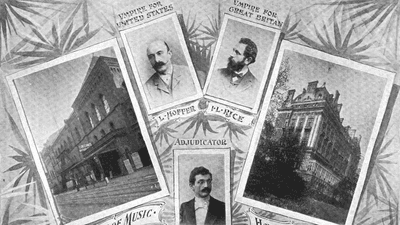
The logistics of this were pretty tricky, and the two legislatures decided to employ seasoned chess players to work the telegraph lines, in an effort to minimize mistaken moves and other errors. At first, there was some confusion over who was playing white, but this was settled with messages passed between the two countries.
"To American Speaker—I am glad to hear that a friendly match is about begin between the two Houses, and trust this is the most serious conflict in which they will ever meet," the UK said, to which the US replied with a little trash talk.
“Speaker to Speaker — Thanks for your friendly message. Please convey to the players my regret that I cannot send best wishes just now, but hope to do so always hereafter.—T. B. Reed, Speaker.”
Moves passed pretty efficiently through the undersea trans-Atlantic cables, taking only around 40 seconds to be transmitted. On the second day of the chess games, played by members of each legislature who had proved their skills in local games, 20 moves were exchanged over around 20 minutes.
Unfortunately, none of the games appear to have been digitized, and we will never know how badly these amateur chess players played, though we do know the results. In the end, with the US winning two and the UK winning another two, and the fifth ending in a draw, the two sides were equal, at least in terms of their chess skills.
But the outcome was pretty by-the-by, with the game genuinely seeming to promote some good feelings between the two countries, with one MP reportedly remarking “one man among the players may at some time prevent war because he has a chess-player friend in England or in the United States.”
As always, make chess blunders, not war.


 2
2