Nature
 PUBLISHED


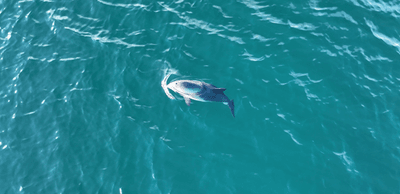


Studying marine creatures is challenging at the best of times, but when you’re trying to look at the smallest cetacean in UK waters things can get even trickier. This is where drones come in – rare footage of harbour porpoise breeding behavior has been captured in the waters around Shetland.
Harbor porpoises (Phocoena phocoena) are frequently spotted around Scotland’s coast, and are speedy small creatures that can measure between 1.5 and 2 meters (4.9-6 feet) and weigh around 55-80 kilograms (121-176 pounds). Adult females are usually slightly longer and heavier than the males. Despite this, they are tricky to study because they spend much of their time underwater.
Shetland is an archipelago in the North Atlantic around 170 kilometers (106 miles) from mainland Scotland.
“Harbour porpoises are seen from land around Shetland all year round, but one sighting involved intense splashing at the surface. We realised it might be mating behaviour,” said Sophie Ariadne Francine Smith from UHI Shetland, who carried out the research, in a statement. “It is incredibly difficult to film porpoises from boats or from land. They don’t spend much time at the water's surface, don’t follow a predictable line, like an orca, and they are incredibly fast.”
Overall, the team managed to record 79 minutes from four coastal locations around the east and south of Shetland between 2019 and 2023. The biggest gathering the team filmed was made up of 26 animals in one single location, whereas typical reports list no more than two or three porpoises together; in other areas, as many as 100 porpoises have been seen together.
The researchers also witnessed two types of mating behavior. The first showed males rapidly approaching females in what the team believe to be mating attempts, often seen as only a splash from the shore, while the second is a display behavior involving the males showing their bellies to the females.
“Drone technology means we can film them from above, which gives much more accurate accounts and a clearer interpretation of behaviour,” said Smith. “Harbour porpoises are fast and elusive. For much of this mating behaviour they only broke the surface for a few seconds - blink and you’d miss it, which is why using drones to capture footage has been such a boon.”
The study is published in Journal of the Marine Biological Association of the United Kingdom.