Nature
 PUBLISHED


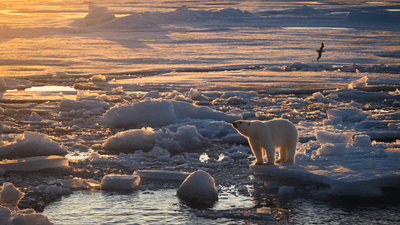


It’s no secret that polar bears in the Arctic are vulnerable to sea ice loss, but a curious finding has emerged from a new long-term study of bears in Svalbard. It found that adult polar bears have largely maintained good body condition from 1995 to 2019 despite this being a period of rapid and significant sea ice loss.
What feels like a rare bit of good news for polar bears is a more complex picture, however. The behavioral plasticity that’s enabled them to continue to chunk up will only get them so far, and if sea ice loss reaches a critical point, the world will no longer have polar bears.
Unlike like the land mass known as Antarctica (where there are no bears, but the name’s a happy accident), the Arctic is an ocean covered with sea ice. This highly transient habitat is critical for Ursus maritimus (which translates to “sea bear”) as it’s where polar bears create maternal dens to raise their young and hunt high-calorie prey like seals and whales.
Take away that sea ice with a bit of summer Sun and an emissions-driven climate crisis, and the polar bears are forced onto land. This includes Svalbard, the site of focus for this latest research. Here, it appears one way in which polar bears could be responding to fewer days of sea ice per year is by hunting more reindeer.
“It's not really a new behaviour for the bears but what we are seeing is more reports of polar bears killing reindeer,” said Dr Andrew Derocher, report co-author and Professor of Biological Sciences at the University of Alberta, to IFLScience. “Polar bears learn very quickly so if an individual figures out that reindeer can be caught, they'll come back to where they were successful in the past and keep trying to hunt them again.”
Once sea ice declines too much, we won't have polar bears.
Dr Andrew Derocher
While polar bears are proficient hunters capable of killing caribou, which run much faster than reindeer, they’re built for hunting seals. It’s probably a lucky or skilled few capable of hunting speedy terrestrial mammals, but there are a few other supplemental prey items that could explain why the polar bears' body condition has remained stable.
Polar bears around Svalbard will also eat harbor seals and walruses, but they’re lower-value alternatives compared to ringed seals and bearded seals. They just aren’t as calorie-rich or abundantly available, so while they’ll do for now, it won’t last.
“Arctic ecosystems are definitely changing but largely to the detriment of polar bears in the longer term,” said Derocher. “The changes we're seeing in Svalbard and the bears sustaining themselves with ‘other’ prey is likely a transient dynamic: it will be OK for a while, until it isn't. Once sea ice declines too much, we won't have polar bears.”
The report highlights that polar bear health is highly specific to the population. While bears in the biodiverse regions of Svalbard and the Barents Sea area are maintaining good body condition, this doesn’t mean that they’re safe from climate change, and eventually this temporary buffer won’t be enough to sustain them.
The finding also only applies to a single measure of population health, and recent research has found that more ice-free days can have a negative influence on the survival of cubs, subadults, and older females. Earlier onset of sea ice melt can also reduce litter sizes, and without new cubs a few pleasingly chunky adults won’t be enough to sustain a healthy future for Svalbard’s polar bears.
The study is published in the journal Scientific Reports.