Nature
 PUBLISHED
 1
1


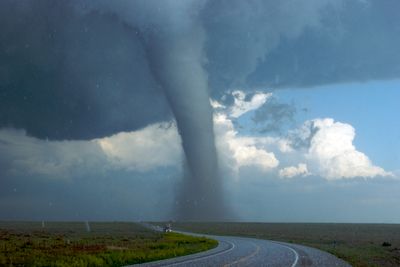


The southern Plains of the US are now in the midst of “tornado season”, but this year’s peak of violent storms has already brought with it one of the most unusual types of twister – one that spins clockwise.
On the evening of April 30, a powerful thunderstorm known as a supercell made its way east across Oklahoma. Not only do supercells often bring strong winds and large hailstones, but they can also spawn tornadoes, and this one birthed multiple.
That’s not exactly an odd occurrence given that tornadoes produced by supercells are the most common kind, but around 10:26 pm CDT, near the town of Loveland, the storm gave rise to a super-rare anticyclonic tornado.
Tornadoes that occur in the Northern Hemisphere normally rotate anticlockwise, but in an estimated 1 percent of cases, they instead spin clockwise. Such anticyclonic tornadoes are normally fairly weak, tornado analyst Paul Robinson told the Washington Post in 2013.
On this occasion, however, the unusual tornado continued to go against convention as it remained powerful, with the National Weather Service (NWS) putting out a statement deeming the twister as “large and extremely dangerous”. Luckily, it occurred mostly over farmland, with no reported casualties – just a lot of uprooted trees.
The statement also revealed that at one point, the tornado achieved something else out of the ordinary: it was “nearly stationary”, or at the very least moving extremely slowly.
“It’s not common to see (tornadoes) be nearly stationary,” NWS meteorologist Rick Smith explained to CNN. “Tornadoes are almost always going to just go wherever the supercell thunderstorm goes.”
This atypical tornado was far from the only one getting things a bit backward that day. Normally, tornadoes in the US travel from west to east, but the mother supercell popped out another irregular offspring that ended up looping back over the path it just took.
According to Smith, it’s possible that the two unusual tornadoes were even active at the same time. “You certainly don’t see this every day,” said the meteorologist.
Though tornadoes can happen at any time, the spring months usually see an uptick in storms in the US, with the peak “tornado season” for states such as Oklahoma occurring from May to early June and through to July further north. The lead up to this year’s season has been pretty busy, with the NWS Storm Prediction Center reporting a preliminary figure of 300 tornadoes in the US during April, the second highest figure for the month on record.