


 Nature
 PUBLISHED


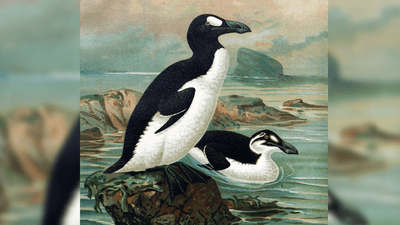


Animals in the 1800s really got the raw deal of humanity; Homo sapiens successfully wiped out the bluebuck, brought the American bison to the brink of extinction, and was already well on its way to wiping out the thylacine, too. The great auk also fell victim, with the last pair being killed off in the mid-1800s – but how did we get it to that point?
Great auks were large, flightless, black and white birds that lived on the coasts of the North Atlantic, where their population was said to number into the millions; the largest known breeding colony was found on an island just off the coast of Newfoundland, Canada. They weighed about 5 kilograms (11 pounds), could grow to 85 centimeters tall (33 inches), and had pretty small wings.
Given their proclivity for nesting on remote rocky outcrops, not a whole lot is known about their behavior. However, great auks were known to be similar to penguins (though not actually related to them) in that they were extremely nimble in the water and were able to chase after small fish.
The birds were also hunted for their meat, fat, eggs, and feathers, but by the late 1770s, overhunting was beginning to be a real problem for the species; European fishers and whalers basically wiped out the largest colony. Interestingly, museums also drove the extinction of these birds in the later years of their decline, wanting to preserve and display the skins and eggs of these birds, rather than protecting the species as a whole.
The last known breeding pair of great auks were killed on Eldey Island, Iceland, in June 1844. Their deaths were brutal; the birds were chased, caught, and strangled, and in the process their single egg was crushed. Their death signaled the extinction of the species; one last live bird was seen off the coast of Newfoundland in 1852, but the species could never recover.
There is some mystery surrounding the reasons why the fishers that killed the last pair did so. Some suggest they wanted the birds to sell as specimens to collectors, while it has also been proposed that it was down to superstition, the fishers having blamed the auks for causing a storm.
The story gets weirder too, as the organs were preserved and held at museums, but the skins mysteriously disappeared. Nearly 180 years later, the organs of the male bird, currently held at Natural History Museum of Denmark, proved a match to a skin specimen held in the Royal Belgian Institute of Natural Sciences (RBINS), Brussels. In 2025, it was revealed that the skin of the female auk was hiding in the Museum of Natural History and Science in Cincinnati.
Today, the sad tale of the great auk's demise serves as a reminder about the dangerous nature of overconsumption and human greed. While the great auk is gone forever, we can protect our existing nature – or maybe even bring some of it back.




 1
1