Nature
 PUBLISHED



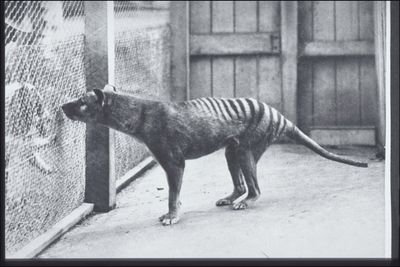


Never mind the mammoth or the moa; few extinct animals capture the imagination quite like the thylacine. There are people alive today who could potentially have seen one of these charismatic creatures with their own eyes, and there are many more who still hold out hope for its survival.
With a head like a wolf, a striped body like a tiger, and a pouch like a kangaroo, thylacines were wonderfully weird animals. Also known as the Tasmanian tiger or Tasmanian wolf, this carnivorous species might look a bit like a canine or feline, but it is actually a marsupial that's more closely related to kangaroos, koalas, wombats, and wallabies.
The species was once found across Australia, as well as Papua New Guinea, until it was wiped from the mainland around 3,600 to 3,200 years ago. It’s not totally certain why this happened, but one theory suggests they were outcompeted by the arrival of the dingo.
Fortunately, a population had become isolated on the Australian island of Tasmania, where they managed to hold on to survival for many more millennia. New pressure arrived in the age of European colonization, a time when agriculture and overhunting pushed the already troubled species into dire straits. Farmers put private bounties on the animals during the 1840s, claiming they were preying on their livestock, and they were even subjected to a government-sponsored cull in the 1880s.
Despite these threats, they survived in the wild until at least the 1930s. Some computer modeling, based on a string of later suspected sightings, suggests the thylacine might have actually fallen extinct sometime between the 1940s and 1970s, or perhaps as late as the 1980s to 2000s, with rogue populations lurking in the sticks of Tasmania. Not everyone agrees with these conclusions, but it's an intriguing thought.
The most widely accepted story is that the last thylacine (Thylacinus cynocephalus) died in the Beaumaris Zoo in Hobart on September 7, 1936, just two months after the species had been given protected status.
It’s often said this lone individual was named “Benjamin.” However, thylacine experts have since said this is nonsense. They claim the idea was invented in the 1960s by a man named Frank Darby who falsely claimed to be a curator at the Hobart Zoo during the 1930s. Among the many holes in his story, experts now believe that "Benjamin" was, perhaps, a female.
"It was a female, and it certainly was not called Benjamin. It is an unfortunate myth [created by] a bullsh*t artist of the first degree,” Robert Paddle, a researcher and author of The Last Tasmanian Tiger: The History and Extinction of the Thylacine, said in 2022, according to the Australian Broadcasting Corporation.
Darby also fed the media colorful stories of "Benjamin" being given live animals to kill for the entertainment of zoo guests. This, along with much else attributed to Darby, should be struck from the record entirely, Paddle argued.
"What he said is tragic, it is time to remove it from the literature," he said.
Paddle was part of a group that managed to identify the skeleton of the last thylacine. It was thought the body had been disposed of, but they found the remains in an unlabeled box at the Tasmanian Museum and Art Gallery.
There’s also some ambiguity about the last piece of footage of a thylacine. The black-and-white video appears to show a lonely individual wandering around its cage at Hobart Zoo. However, it turns out, the animal in this footage may actually be the penultimate thylacine.
These layers of uncertainty and mistaken identity are perhaps part of why some people refuse to let the thylacine go. Poke around the internet, and you'll find semi-organized groups of die-hard enthusiasts who are convinced the animal still roams the Tasmanian wilderness. They regularly share tracks, scat trails, and blurry footage as evidence of its continued existence.
Most scientists don't seriously entertain the idea. But perhaps this stubborn longing is simply a reflection of how deeply the thylacine and Australia's great wildlife mean to people.