Nature
 PUBLISHED
 3
3


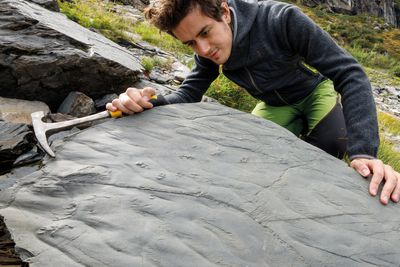


The fossilized remains of an entire prehistoric ecosystem, complete with footprints of extinct animals, have been discovered by accident in the Italian Alps. Dating to 280 million years ago, the creatures that created these vivid impressions were alive during the Permian period, a time long before dinosaurs emerged in the Triassic period.
The stunning find was first stumbled upon by Claudia Steffensen while hiking around Val d’Ambria in the municipality of Piateda at an altitude of 1,700 meters (5,577 feet).
She told her friend Elio Della Ferrera, a nature photographer, who sent some images to scientists at the Natural History Museum of Milan. They then passed it on to specialists at the University of Pavia and the Leibniz Institute for Research on Evolution and Biodiversity in Berlin who confirmed that it was indeed a very special specimen.
Embedded within the slabs of sandstone, the footprints of at least five different animal species have been identified, including tetrapods (reptiles and amphibians) and invertebrates (insects and arthropods).
“Dinosaurs did not yet exist at that time, but the authors of the largest footprints found here must have been still considerable in size: up to 2-3 meters in length,” Cristiano Dal Sasso, a palaeontologist at the Natural History Museum of Milan, said in a statement.

“The very fine grain of the sediments, now petrified, has allowed the preservation of sometimes impressive details, such as the imprints of the fingertips and the belly skin of some animals,” explained Lorenzo Marchetti of the Leibniz Institute for Research on Evolution and Biodiversity.
Along with the traces of animal life, the rock also contains plant fossils of leaves, stem fragments, and seeds, as well as the imprinted ripples of waves from the shores of ancient lakes and even drops of rain that fell on the mud.
“The footprints were imprinted when these sandstones and clays were still sands and muds soaked in water, at the edges of rivers and lakes that periodically, according to the seasons, dried up. The summer Sun, drying those surfaces, hardened them to the point that the return of new water did not erase the footprints but, on the contrary, covered them with new clay forming a protective layer,” added Ausonio Ronchi from the Department of Earth and Environmental Sciences at the University of Pavia.
The preserved ecosystem ended up at the top of a mountain due to the colossal geological forces of planet Earth. The Alps began to form tens of millions of years ago when the African and Eurasian tectonic plates slowly crashed into each other, causing the layers of rock that had settled on the bed of the ancient Tethys Sea to crumple up into a vast chain of mountains.

Here, the relics laid undisturbed for thousands, if not millions, of years – until very recently. The chance discovery was only made possible due to warming temperatures linked to human-made climate change, which have wreaked havoc on the region’s glaciers and snowcaps. As the snow and ice recede, they reveal long-lost artifacts of the distant past.
“These fossils bear witness to a distant geological period, but with a global warming trend completely analogous to that of today, with an increase in the greenhouse effect (then caused by immense volcanic eruptions), melting of the polar ice caps, and the development of highly seasonal and increasingly arid tropical environments, which at the time favored reptiles over amphibians and caused the extinction of many other animals,” commented Stefano Rossi, the Superintendency of Archaeology, Fine Arts and Landscape for the provinces of Como, Lecco, Monza-Brianza, Pavia, Sondrio, and Varese.
“The past has a lot to teach us," Rossi noted.