Space and Physics
 PUBLISHED
 10
10


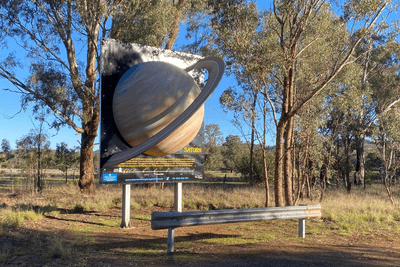


Pictures of the Sun and planets together are almost always misleading. To make the planets large enough to see, they have to be represented on a different scale from the voids between them, and usually even from the size of the Sun. Scale models of the Solar System address this, giving a sense of just how vast the distances between planets are, and the bigger the model, the more it drives the point home.
Despite Douglas Adams’ efforts, there’s simply no way words can convey how large space is, but models are a different matter. IFLScience visited the Solar System Drive, which when built was the largest model of the Solar System in the world.
The Sun is represented in the system by the dome of the Anglo-Australian Telescope. At 37 meters (113 feet) wide, the dome is 38 million times smaller than the Sun. On that scale, the Earth is 34 centimeters (1.1 feet) wide, Jupiter 3.7 meters (12.3 feet) and Mercury 12.8 cm (5 inches); fiberglass models of each planet were built, and placed at suitable distances from the Siding Spring Observatory, where the dome is located.
The innermost three planets are on the drive up the mountain to the observatory, while Mars and Jupiter are on the road to Coonabarabran, the nearest town. Each has been carefully positioned so that the model is 38 million times closer to the dome than the relevant planet is to the Sun.
From there things get a little more complicated. Models of Saturn, Uranus, Neptune, and Pluto (it was a planet when everything was built, and no one has had the heart to take it down) have been located along the major roads that converge at Coonabarabran.
The outer planet models are also to scale, but the placement is a bit more dicey – some of them have been sited at town visitor centers that don’t always serve as an exact match for the 1:38,000,000 scale. For example, on the highway to Merriwa Saturn is 41 kilometers (25 miles) from the dome, while on the road to Tamworth it’s 34 km (21 miles). Even allowing for the fact Saturn’s orbit is not perfectly circular, there’s a bit of poetic license there.
Such quibbles aside, however, the model does help one grasp the scale of the system in ways nothing else really does. The most distant of the planets, Pluto, is 205 km (123 miles) from the dome, while the closest one is 157 km (95 miles) away. When you started your journey at a Pluto almost too small to spot on its billboard, and have been driving for an hour and still not reached Uranus, something clicks.
The model is also a bit of a tourist attraction, bringing a bit of money into a town that took quite a financial hit once astronomers started to be able to do most of their work remotely, and neighboring towns probably benefit as well.
If you drive at the speed limit – which varies on the relevant roads but averages about 100 kph (around 60 mph) – you’re passing the planets at the scale equivalent of three times the speed of light. That is, it would take you two hours to reach one of the Plutos from the dome, but light takes 4-7 hours to get to the real thing. For some people this may feel like piloting the Starship Enterprise, but arguably it’s cheating, and what we really need is a model three times the size.
No such model exists; many countries could not build one without co-operating with their neighbors. The world’s largest is on a 1:20,000,000 scale, and spans almost the entire length of Sweden. It also does a good job of educating people about many of the Solar System’s lesser-known worlds.
Belgium and Canada host models that are only modestly smaller than the Siding Spring one if you’d like to check one out, but are not that much of a traveler. There are also hundreds of much smaller ones, more suited to walking or biking than driving, although the smaller planets are then almost too small to see.
One such model, along a beachfront in Melbourne, is unusual because it also includes Proxima Centauri, the nearest star. To do that it uses a rather sneaky dodge. On the 1:1 billion scale of that system, Proxima Centauri would be 40,140 km (24,942 miles) away, which just happens to be the distance around the Earth via the poles. The makers plonked it a few steps from the Sun, opposite Mercury, and ask visitors to imagine they circumnavigated the Earth to get there.
The Siding Spring model can’t do that. If a model of Proxima was included, it would need to be more than a million kilometers away, almost three times as far away as the Moon, much farther than any human has traveled.