Space and Physics
 PUBLISHED
 5
5


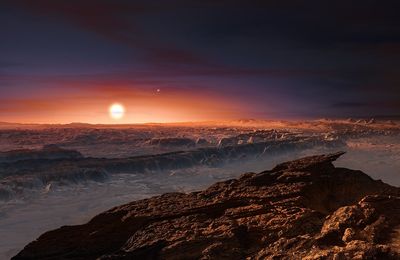


The spectrum produced by Proxima Centauri, the nearest star to the Sun, has been interpreted as indicating the planets Proxima b and d both have magnetic fields many times stronger than Earth’s. If true, this would force a rethink of the assessment that neither of the pair – the closest exoplanets (planets outside the Solar System) to Earth – could support life, as well as increasing the prospects for life more broadly.
Three years of observations of Proxima show it flaring a remarkable 24.8 percent of the time, vastly more than our relatively placid Sun. The flares appear to be dictated by the location of the inner planet Proxima d, but the most significant aspect of the work is the possibility that Proxima b exerts a more subtle influence.
When a team led by Dr Maria Rosa Zapatero Osorio of Spain’s Center for Astrobiology looked for the fingerprints of certain ions in the Proxima spectrum they noticed that some, particularly Fe1, varied on a 5.1-day timescale. That matches the orbit of Proxima d. This variation would make sense if Proxima d has a magnetic field of 8-230 Gauss (best estimate in such an immense range is 16 G). For comparison, Earth’s field is 0.6 G.
Proxima d is too hot, and probably too small, to be a candidate for life, but Proxima b is another matter. Zapatero Osorio and co-authors didn’t find evidence Proxima b is causing flares the way its inner companion is, but they did find signs the spectrum for four elements is being modulated on an 11-day cycle, equalling Proxima b’s orbit.
At least one alternative explanation for this cycle is possible, the authors admit, but the simplest is that Proxima b also has a magnetic field strong enough to influence flares from its star. That would have to also be a great deal stronger than Earth’s.
When Proxima b was discovered in 2016 it set off a storm of excitement. Not only was this the closest an exoplanet could realistically be to Earth, and therefore a great opportunity for study, but it was roughly Earth-sized and right in the system’s habitable zone.
Then, however, disappointment set in. Habitability requires not only suitable temperatures, which Proxima b probably has, but an atmosphere, which would allow liquid water to exist on the planet.
Unfortunately, Proxima is so faint that its habitable zone is very close to the star, and those frequent flares contain a lot of high energy UV light. The UV, it was concluded, would rapidly strip away any atmosphere, even one initially much thicker than Earth’s. More optimistic astronomers suggested that a powerful magnetic field might protect Proxima b from these flares, but it soon became clear the field would need to be dramatically stronger than Earth’s and what were the chances of that?
Better than we thought, it seems.
Earth is the only rocky planet in our Solar System with a magnetic field strong enough to offer much protection, so it’s reasonable to think of it as an anomaly. We might hope that some Earth-like planets would have similar strength magnetic fields, sufficient to protect life from Sun-like stars. Modeling suggests that may be common, but until now there was no reason to expect vastly stronger ones.
Indeed, the same modeling suggests that even planets twice the size of Earth would have fields only modestly stronger than our own. Certainly, Jupiter has a much more powerful magnetic field than Earth, but everything’s bigger on Jupiter. It’s not much of an indicator for planets of a size suited to life.
Even the conclusions about Proxima d will need verification, and those relating to Proxima b are even more speculative. However, if the work stands up, it restores Proxima b to the list of places where life might exist, or at least host an atmosphere we’d like to study.
Moreover, the if the field for Proxima d – which, as mentioned, is far too hot to support life itself – is real, it would suggest other rocky planets may have similarly strong fields. That would mean many other exoplanets orbiting red dwarfs, the most common type of star, might have kept their atmospheres and deserve further study.
The announcement this week that seven ultra-hot Jupiter-sized planets have powerful magnetic fields, strengthens the suspicion that magnetic fields may be a common feature of planets, although that research was on worlds unsuitable for life themselves.
The study has been accepted for publication in Astronomy and Astrophysics. A preprint is available via arXiv.
[H/T: Kyplanet]