Space and Physics
 PUBLISHED



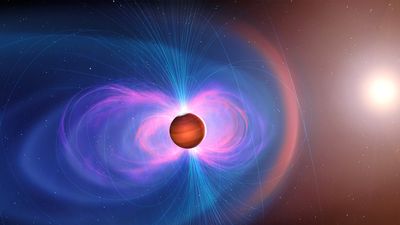


The magnetic fields of the Solar System’s planets are a mixed bag. Earth’s keeps us alive, Jupiter’s is one of the largest structures in the Solar System, and Uranus's is an utter mess. It is an obvious expectation for exoplanets to also have magnetic fields, but finding them turned out to be a thankless task. Until today.
A team led by Julia Seidel, an astronomer at Côte d'Azur Observatory in France, has found the strongest hint yet of magnetic fields around not one but seven exoplanets. What’s particularly exciting is that they weren't even looking for them. They were actually studying wind.
The team had selected seven ultra-hot Jupiters, giant planets like the one we know and love but that orbit so close to their host stars that they heat up to over 2,000 Kelvin. The proximity to the star also tidally locks the planets so one side always faces the star.
The high temperature and divide between the scorching day side and cooler night side lead to the formation of high-speed winds: they go from 7,200 to 25,000 kilometers (4,500 to 15,500 miles) per hour. That's many times the speed of the fastest winds of Jupiter.
“What you would expect is you put more energy into your planet, and the winds get faster,” Seidel told IFLScience. “And then what we realized when we looked at the data from the measurements is actually the hotter the planets are in our little population survey, the less strong the winds are, as if something were braking the winds.”
These extremely hot atmospheres are filled with electrically charged particles. While other explanations were investigated to explain this braking effect, the presence of planet-wide magnetic fields makes the most sense.
“Very counter-intuitively, looking at the atmospheres, we can actually say something about a completely different characteristic of planets,” Seidel continued.
The discovery, made possible thanks to observations from the Gemini North telescope in Hawai‘i and the European Southern Observatory’s Very Large Telescope, opens several doors when it comes to studying planetary atmospheres and magnetic fields.
“Exoplanets do have magnetic fields,” Seidel told us. “And as we know, magnetic fields are super important to understand what makes planets have atmospheres in the first place.”
Seidel's colleagues are already trying to observe these magnetic fields directly thanks to the insights from this work. They hope to see magnetic features as starlight is filtered through the planets’ atmospheres.
Seidel is still focusing on the atmosphere, but now with the goal of understanding what role magnetic fields play in the wide population of gas giant planets out there. Are they important just for the ultra-hot Jupiters? What about the warm ones or the cool ones like our own?
“The question now is: when does the magnetic field stop being the driving force in how atmospheric dynamics work? What temperature is that? And what actually happens to the cooler Jupiters?” Seidel told IFLScience.
The magnetic field of our planet has shielded Earth from danger and helps us retain our atmosphere, unlike poor Mars. Such a field isn't essential, though: Venus has a thicker atmosphere and no magnetic field, for instance. Looking at magnetic fields of exoplanets will provide insights into what makes our planet special.
With the launch of PLATO next year and the Extremely Large Telescope coming online in 2028, followed in the early 2030s by ARIEL and the Giant Magellan Telescope, exoplanet research will be able to look at smaller, cooler objects rather than just these hot ones.
“Learning more about magnetic fields tells us more about why we are here,” Seidel told IFLScience. “For exoplanet research, give us another three, four years, and it will be less about ultra-hot Jupiters and more about rocky, low-temperature “Earth-like” planets.”
A paper describing these results was published in the journal Nature Astronomy.