Nature
 PUBLISHED
 3
3


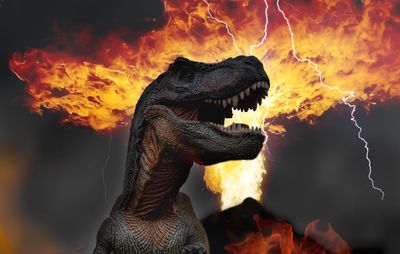


What killed off the dinosaurs? For many, the matter is settled – and there’s a huge crater down in Mexico to act as evidence. However, a minority of experts were unconvinced, arguing instead that the Chicxulub meteorite impact was simply a bombastic end to an extinction that was already underway – one that was being caused by a seemingly endless period of massive volcanic eruptions in what is now central India.
A new paper from scientists at Utrecht University and the University of Manchester claims to have put that hypothesis firmly to rest, however. By analyzing lipids in ancient fossil peats from Pyramid Butte, North Dakota, and West Bijou, Colorado, the researchers were able to reconstruct the mean annual air temperatures from the period leading up to the K-Pg boundary – that is, the point at which the Cretaceous period ended and the Paleogene began.
“We were able to create a detailed ‘temperature timeline’ for the years leading up to the dinosaur extinction,” explained Dr Lauren O’Connor, a researcher in organic geochemistry at Utrecht University and lead author of the new paper, in a statement, “which we can compare to the fossil record to understand the relative timing of events.”
What they found was enough to rewrite the story of the last days of the dinosaurs – but not by much. The researchers found evidence of a previously unknown cooling event, in which the world got between 2-5°C (2.6-9°F) colder over a period of no more than 10,000 years. That was probably due to the volcanism – the timeline certainly adds up – but it was too early to wipe out the dinosaurs, the team argues.
“These volcanic eruptions and associated CO2 and sulfur release would have had drastic consequences for life on earth,” O’Connor said. “But these events happened millennia before the meteorite impact and probably played only a small part in the extinction of dinosaurs.”
Crucially, the team found that temperatures had pretty much recovered to their pre-eruption state well before the meteorite made its fateful debut – as in, 20,000 years before. It’s not that the volcanoes wouldn’t have had an impact at all – the eruptions lasted for around 800,000 years and left behind 1.3 million cubic kilometers of basalt, so it’s hardly a stretch to think that they would have affected the climate too.
But those effects simply weren’t the kind that could cause a mass extinction of the dinosaurs, the team concludes. “By comparison, the impact from the asteroid unleashed a chain of disasters,” said Rhodri Jerrett, a lecturer in geology at the University of Manchester and a co-author of the paper, “including wildfires, earthquakes, tsunamis, and an ‘impact winter’ that blocked sunlight and devastated ecosystems.”
“We believe [it was] the asteroid that ultimately delivered the fatal blow,” he said.
The paper is published in the journal Science Advances.