Nature
 PUBLISHED


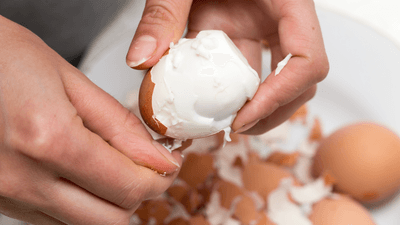


A boiled egg. What could be better? A perfect pod of fats, protein, and flavor, handily packaged in a crackable shell that’s tough enough to survive boiling so that when you rip it away there’s a bouncy egg waiting inside. Only problem is, peeling boiled eggs is the worst thing ever.
Flecks of calcium carbonate, weird flimsy membranes, and now – worst of all – the egg is in tatters. Well, fear not my red-faced oeuf eater, science has some advice.
A good boiling eggxperience (sorry, it was right there) begins with understanding your subject. First, there’s the shell, which is made almost entirely of calcium carbonate. Beneath that, you'll find some very fine inner and outer membranes, plus a small air pocket before you get to the good gooey bit. Then we have the albumen, which are our egg whites (curiously, the egg “whites” of penguin eggs actually stay see-through when boiled), and of course, there’s that nutritionally dense yellow yolk.
As Professor in Food Science Paulomi Burey of the University of Southern Queensland wrote for The Conversation, a number of egg studies in the 1960s earmarked the pH of the albumen as a key contributor to peelability, as well as the temperature at which the eggs were stored. You apparently want to aim for around 22°C (72° F) rather than the cooler temperatures of your fridge for storage, and fresh eggs are probably going to be harder to peel compared to older ones (but don’t go eating any spoiled eggs, now).
It's thought this may be due to the air pocket we mentioned earlier, as less fresh eggs will dry gradually, creating more space for the air pocket to grow as moisture is lost. The time spent sitting on storage also tips its pH towards a more apeeling acidity.
Those membranes we spoke about can be crucial because nothing makes for a perfect peel quite like slipping under that freaky lil skin and pulling half the eggshell off like a crackly orange peel. Whether or not the membranes give you a helping hand can come down to temperature, with using boiling water that’s cooled slightly being touted as a better approach than starting off cold. Another reason to keep your eggs out of the fridge, because if they’re cold and you do this they’ll crack, and it’ll all come bubbling out in chaotic bulges. Trust me.
We humans love a cold plunge and the same could be good for your boiled egg post-boiling. The sudden cooling can encourage the egg to move inward from the shell, creating more space for you to work your fingers around clearing the shell. So, in case you’re after a handy breakdown so that you don't have one during your next peeling experience, here are the top tips for peeling a boiled egg according to science:
- Use eggs that haven’t been stored in the fridge, and ideally have been sitting on your shelf a little longer (but that are still in date)
- Pop them into water that has already boiled and then cooled slightly to get the proteins denaturing nice and fast
- Once done to your desired degree of boiling, plunge those babies in an ice bath
Not complicated enough for you? Check out the perfect way to boil an egg according to scientists (spoiler: it takes 32 minutes).



 2
2