


 Nature
 PUBLISHED


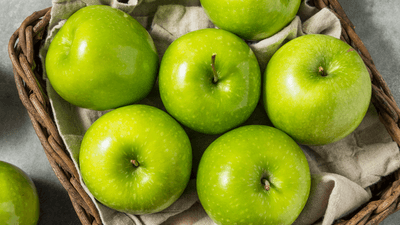


"The apple doesn't fall far from the tree" is a phrase people use when the offspring of somebody or other begins behaving like their parent. While perfectly serviceable as an idiom if you don't think about it too much, it displays levels of misunderstanding of apple production that could do with a little correcting.
For a start, though apples do not fall physically far from a tree, should the seed of that apple go on to produce an apple tree, its apples will be very different from those produced by the parent tree. That itself isn't too surprising, given how they reproduce.
"Apples have a genetic system that generally prohibits self-fertilization. This self-incompatibility system is a way of ensuring that each apple seed will be a hybrid between the maternal (seed) parent and a paternal (pollen) parent," eXtension Apples Community of Practice explains.
"The self-incompatibility system is also the reason why two or more cultivars must be planted in an orchard to achieve fruit production through insect-vectored movement of pollen from one cultivar to the other."
As a result, the offspring plants are genetically different, and their fruit comes with their own distinct flavor and crunch, which isn't always desirable. In fact, the flavor of fruit from trees grown from seed is almost always inferior to the fruit produced by the parent plant (assuming it was a known, and tasty variety)
So, how do we end up with so many uniform varieties? You know that with a Granny Smith you will get a delicious, sharp flavor, for example, whilst with a Red Delicious you have yourself something that belongs in a pie and/or landfill. How do these varieties remain so consistent, when genetics results in such a wide variety of fruit?
The answer is that they are all clones. Centuries ago, humans learned that we could graft a small section of a desirable fruit-producing tree onto a rooting plant of the same or closely-related species.
"Clonal propagation involves taking a cutting of wood that includes a bud from a desirable tree to grow a new tree, called a clone," Zoë Migicovsky, Postdoctoral fellow in the Faculty of Agriculture at Dalhousie University, explained in a piece for The Conversation.
"Any apple orchard composed of one variety, like Gala, Granny Smith or Honeycrisp, is actually an orchard of clones."
While allowing apples to cross-pollinate and produce new tree varieties can produce delicious fruit, it is far less successful than grafting for making apples that humans want to eat. For example, one apple breeding program in Germany took 52,000 seeds and 26 years to produce a grand total of three new varieties of apple.
Meanwhile, cloned apple varieties that we found centuries ago continue to produce the flavors and textures we are seeking all these years later. Granny Smiths, for example, were found by Maria Ann Smith on her creekside tree in Australia, and have been cloned ever since.
"All of the 'Red Delicious' apple (Malus domestica) trees in the world originated from a single tree discovered in Peru, Iowa, in the 1800s," according to a 2019 paper on the topic.
"Thereafter, buds from the original tree were budded onto other apple seedlings, and later interspecific hybrid clones, that serve as rootstocks to produce the millions of 'Delicious' trees that have been grown around the world until the present day."
Some varieties, such as Pomme d’Api, have been claimed to extend back to Roman times. Though there is little evidence that specific apple varieties have survived from then all the way to the present day, Pliny the Elder (everyone's favorite Roman historian) described 24 cultivars way back in the first century CE.
There are no health concerns about consuming cloned fruit. While clones (particularly bananas) may be more vulnerable to disease and fungal infections, clones are used because of the consistency they produce, and that is pretty useful. But we may be missing out on other varieties of apples that may eclipse even the GOAT (Grannysmith Of All Time).
"By using the same handful of parents repeatedly in apple breeding, we are missing out on a lot of the unusual and wonderful variation that is out there," Migicovsky continues.
"Commercial orchards have the same apple variety planted side by side. But our research orchard in Kentville, N.S., has more than 1,000 unique apple trees. Walking among these trees in the fall, you can see, smell and taste the possibilities."
Maybe we should find these possibilities and clone the hell out of them.


 1
1