Nature
 PUBLISHED


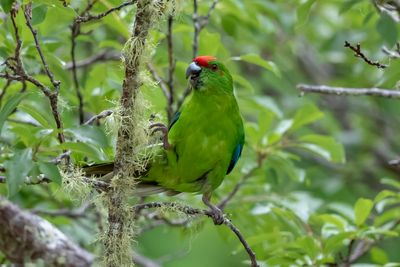


The relationships between animals and their environments are some of the most complex and fascinating that exist. From whales taking time for spa trips, to orangutans using local plants to treat wounds, animals' knowledge of what local flora can make them feel better is pretty damn impressive. New research suggests that Norfolk Island green parrots are also partial to a bit of the local foliage, and have been using plant bark to remove parasites – and maybe even getting themselves high in the process.
Unfortunately, being a Norfolk Island green parrot (Cyanoramphus cookii) is pretty tricky with the amount of ectoparasites you have to look out for. These include things like feather-feeding lice, blood-feeding mites, ticks and fleas, fungi, and bacteria. Not only are these unwanted hitchhikers an annoyance, but they can transmit disease and affect reproductive success and, ultimately, survival.
To remove these pests, birdkind is known to use ants in a process known as “anting”, as well as taking dust and more traditional water baths. Throughout the literature there have been a few reported cases of parrots stripping leaves off plants and either covering their feathers in the resulting juice, or placing the leaves themselves between their feathers.
In the new study, the team observed the parrots visiting young pepper trees (Piper excelsum), where they self-anointed with the vegetation from the pepper trees. Separate observations, one in the winter of 2015 and a series over two summers from 2018-19 to 2019-20, saw birds visit these pepper trees. Once there, the birds bit a section off the lateral shoots and chewed a portion; they then proceeded to preen their feathers, often using preen oil from the uropygial gland. The team saw in their observations that the preen oil and the aromatics from the tree were combined and mixed through the feathers.
The pepper trees contain lots of smelly compounds including piperine, which is known to repel insects as well as having antimicrobial and anti-inflammatory properties. As well as the obvious benefits with regards to parasites, the team think there might be more to this behavior than hygiene.
In an article in The Conversation, study first author Penny Olson explains that the parrots are enjoying themselves during their interactions with the pepper trees and could be getting an extra benefit from the components. Olson suggests that anting, in which the birds are subjected to formic acid, could have a similar effect, with the birds getting high off the fumes.
“Likening green parrots rubbing aromatic vegetation through their plumage to inebriated pigeons falling from trees may seem a stretch. But nature rewards behaviour that offers evolutionary advantage, often, it seems by tapping into animals’ pleasure centres. The pursuit of pleasure is an important, usually overlooked, aspect of animal behaviour, worthy of attention and further research,” concluded Olson.
The study is published in Austral Ecology.