Nature
 PUBLISHED


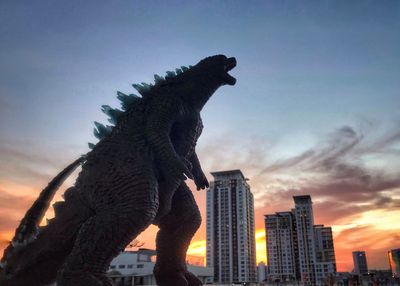


Just as the movies warned, Godzilla quietly lurks at the bottom of the Pacific Ocean. Fortunately, this isn’t a giant radiation-loaded monster with a hatred for moths, but an enormous geological feature found on the seabed.
After 20 years of striving for recognition, it’s official: it’s been agreed that the vast complex of underwater ridges off the coast of Japan will formally be called the Godzilla Megamullion.
In February 2023, the Japan Coast Guard announced the proposed name was finally approved at an international conference organized by the International Hydrographic Organization (IHO) and the UNESCO Intergovernmental Oceanographic Commission (IOC), according to a press release.
First discovered in 2001, the Godzilla Megamullion is located some 600 kilometers (370 miles) southeast of the southernmost island of Japan, Okinotorishima, in the Philippine Sea. It’s essentially a huge complex of ridges that were formed by seafloor spreading, whereby mid-ocean ridges gradually move and "grow", forming new oceanic crust.
This geological seabed feature is the largest known oceanic core complex in the world, stretching for around 125 kilometers (77 miles) in length and 55 kilometers (34 miles) in width, about three times the area of Tokyo.
Given its monstrous size and its clear comparison to the world’s favorite city-wrecking beast (no offense, King Kong), the structure became known as Godzilla and, eventually, the Godzilla Megamullion Province.
It's now much more than a nickname. Thanks to this recent approval, the feature will be labeled as the Godzilla Megamullion on all official documents, maps, and research papers. The new official labeling system even breaks down the parts of the geological feature and names them after different body parts of Godzilla, such as the head peak, neck peak, west arm rise, north tail rise, and so on.
In a world of copyright laws and multi-million dollar movie franchises, obtaining the name wasn’t straightforward. Even before convincing the scientific authorities, the Japan Coast Guard reportedly had to get permission to use the name from Toho Co., which owns the rights to the Godzilla franchise.
Thankfully, the Japanese film production giant said they were “truly honored” by the suggestion and gave the thumbs up.
[H/T: Eos]