Nature
 PUBLISHED


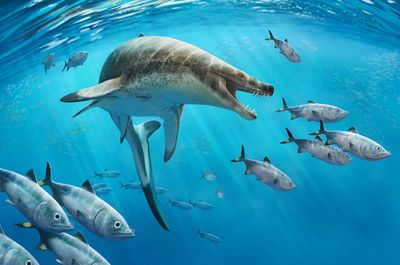


There are few weird sea creatures we here at IFLScience can resist and new giant sea monsters from the Cretaceous period are not one of them. A new species of mosasaurid from the Maastrichtian age has been discovered in Morocco with dagger-like teeth and a bizarrely shaped skull and even scientists have called it "strange".
The new discovery has been named Khinjaria acuta and is a plioplatecarpus, a specialized subset of the mosasaurs that were known to be speedy swimmers and specialized hunters. The international team found the fossil in the Phosphates of Sidi Chennane, in the Oulad Abdoun Basin Khouribga Province in Morocco.
“The phosphates of Morocco immerse us in the Upper Cretaceous seas during the latest geological times of the dinosaurs’ age. No deposit has provided so many fossils and so many species from this period,” explained Professor NE. Jalil of the Museum National d’ Histoire Naturelle in Paris in a statement sent to IFLScience.
The name comes from the Arabic word “khinhar” meaning dagger and the Latin word “acuta” meaning sharp, referencing the large, sharp teeth of the specimen. “Some mosasaurs had teeth to pierce prey, others to cut, tear, or crush. Now we have Khinjaria, with a short face full of huge, dagger-shaped teeth," said lead author Dr Nick Longrich of the University of Bath.
It would have swum around in what is now the Atlantic Ocean at the same time triceratops was roaming around on land, before the end of the Cretaceous period roughly 66 million years ago. "This is one of the most diverse marine faunas seen anywhere, at any time in history, and it existed just before the marine reptiles and the dinosaurs went extinct,” Longrich said.
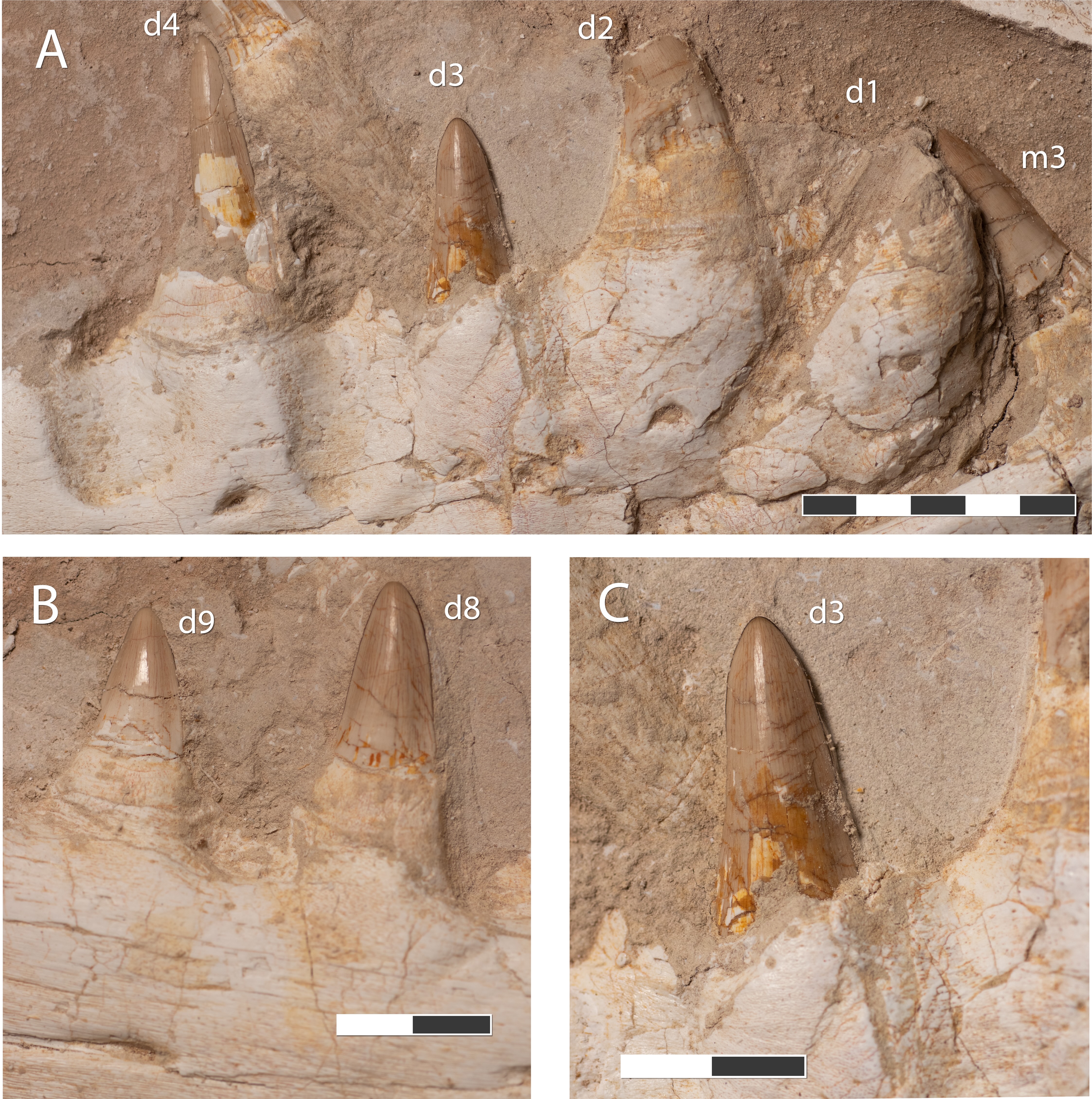
The specimen consists of part of the skull, some vertebrates, part of the jaw, and the teeth. The team thinks the marine lizard would have been around the size of an orca at roughly 7-8 meters long ( 22 - 26 feet).
Analysis reveals that Khinjaria acuta is closely related to another species, Goronyosaurus nigeriensis, and they both possess the unusual appearance of having a short snout and a long area at the back of the skull. The team thinks that this strange skull shape made the jaws of the mosasaur close slowly but with the said high bite force.
"The elongation of the posterior part of the skull which accommodated the jaw musculature suggests a terrible biting force,” said Professor Jalil. Based on the teeth morphology they suspect that Khinjaria likely fed on large fish species or even sharks or other mosasaurs.
While all of these factors of large teeth, large bite force, and large size suggest a predator, the researchers think that Khinkaria hunted in a more unusual way to avoid competing with other predators of that time. Based on the small size of the eye sockets and the shape of the snout, using a sense of smell could have been important in hunting behavior particularly if hunting at night or in murky waters.
Mosasaurs are fairly well-studied marine predators well known from the fossil record for possessing different teeth and variations in skull shape, which suggests a wide range of diets and niches for these ancient marine reptiles to occupy. The new study adds to evidence that ocean ecosystems were very different millions of years ago when they could support multiple apex predators eating large prey, as opposed to now where just a few large predators like orcas and great whites dominate.
The study is published in Cretaceous Research.