


 Nature
 PUBLISHED



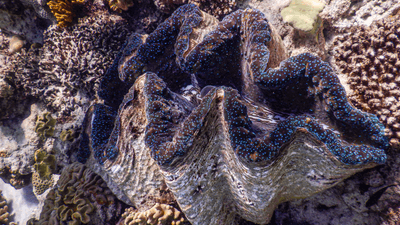


To have food al dente means “with bite”, but some menu items you don’t expect to have teeth. Just look at the juicy bivalves like clams and oysters. These shellfish actually do have teeth, just not where you’d expect.
Known as hinge teeth, they maintain alignment between the two valves that define this group of animals. The valve is the technical name for each half of the paired shell.
After all, what could be sadder than a clam with lockjaw?
Clam gnashers
The clam life cycle begins with a spray of gametes, as males and females release sperm and eggs into the water. Once fertilized, the embryo develops into a free-swimming larva that eventually settles on the seafloor.
This next stage is known as a spat, and the larva can move along the sediment thanks to a muscular foot - much like other mollusks. It then burrows down, becomes sessile, and starts forming its shell for adulthood.
They might not flap around the ocean with the enthusiasm of a disco-light-loving scallop, but clams do still move. Giant clams open their shells so that the symbiotic algae inside can photosynthesize, but they can slam shut again if their simple eyes detect movement.
Wouldn’t it be awful, then, as a two-part organism, to accidentally close slightly out of alignment? Well, the bivalves evolved their hinge teeth to prevent just that.
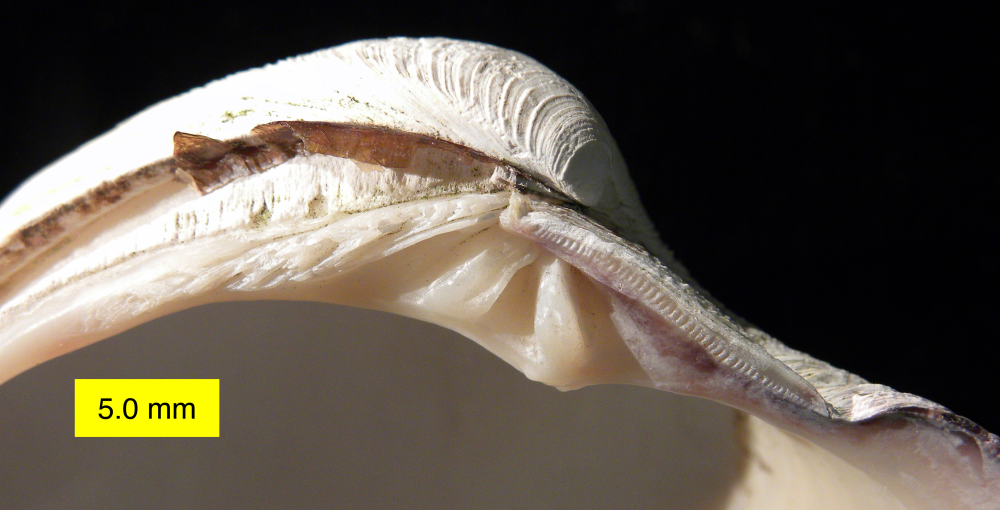
Along the hinge between the bivalve's shells, there is a strong ligament that helps them snap closed. The "teeth" are a typically ridged structure not unlike a zip that prevents the shells from closing at an odd angle.
The arrangement of the structures are known collectively as the “dentition”, but they’re a long way from the gnashers in our mouths. They’re not used for feeding and are made up of calcium carbonate, the same as their hard shell.
Still, it’s a nifty trait for taxonomists trying to tell bivalves apart.
Different shapes, lengths, and ridge patterns can all be clues to revealing new species. While most bivalves have hinge teeth, they’re not a universal trait so a lack of them is also a telltale sign.
An example of the delicate structures engineered by evolution to answer simple questions such as: how will I close today?
But there are more dramatic examples of teeth where they ought not to be in nature.
When is a tooth not a tooth
If you’ve ever stared down the hissing beak of a goose, you may have noticed they have what look like teeth lining either side of their mouths. Pretty threatening on an already terrifying bird, but like clams these teeth aren’t what they seem.
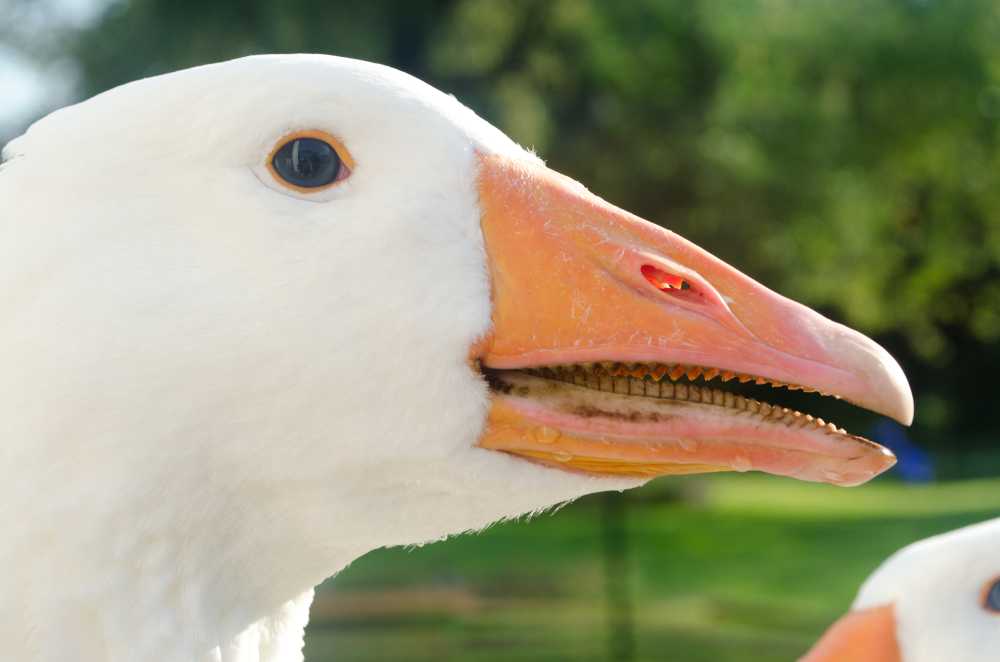
“Geese don’t have teeth in the normal sense of the word,” said Vanessa Amaral-Rogers of the RSPB to IFLScience. “Teeth are made from enamel, and these spiky-looking structures are made from cartilage – known as tomia (singular tomium).”
“The serrated protrusions are part of the beak and tongue but act in the same way that regular teeth do. They are also very sharp!”
And if you like your toothy animals a little more marine, then how about the oyster discovered in 1898 with a full set of pearly whites?
This specimen, housed at the Smithsonian, is the result of an oyster spat deciding a discarded pair of dentures was the perfect permanent home.
A set to put your hinge teeth to shame, but when the oyster hit the papers, it even sparked something of a local scandal.




 1
1