Nature
 PUBLISHED
 1
1


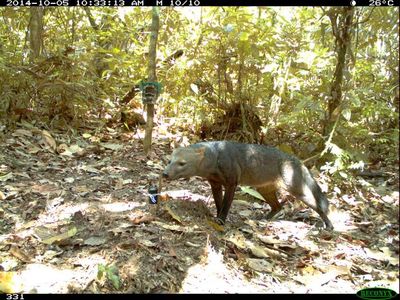


Using a network of hidden cameras in select parts of the Amazon rainforest, scientists at the Wildlife Conservation Society are pulling back the veil on the short-eared dog, a mysterious canid nicknamed the "ghost dog" for their highly elusive nature.
The study began over 25 years ago when researchers placed dozens of camera traps across the lowland regions of Bolivia and Peru, primarily in the Greater Madidi-Tambopata and Llanos de Moxos Biocultural Landscapes.
Thanks to this work, the team has since collected over 594 images of short-eared dogs in the wild, along with fleeting glimpses of other shy jungle predators, including ocelots and jaguars.
Up until recently, knowledge of the species was remarkably sparse, consisting of just six recorded localities, four museum specimens, and two direct observations by experienced field biologists. A surge of fieldwork in the past few years has started to expand our knowledge, but this new research is providing one of the deepest looks into the species to date.
New insights into the species
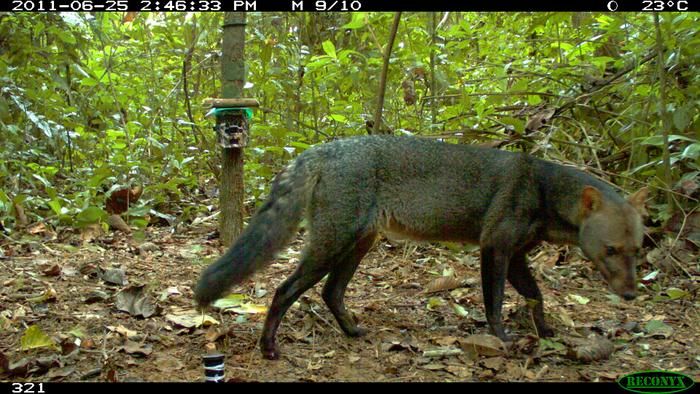
The newly compiled images offer a detailed picture of the short-eared dog's good looks. As the name not-so-subtly suggests, they have very small, rounded ears, as well as a large head, a dense coat ranging from blackish-grey to reddish-brown, a bushy tail, and a relatively long yet stocky body.
Most strikingly, they appear to have semi-webbed feet, a trait that's unique among Amazonian canids. This hints that they have some experience with paddling around aquatic environments, although the species tends to spend most of its time in upland forests away from rivers.
Their lifestyle also appears to be primarily diurnal, meaning they are most active during the day, with activity peaking between 6:00 am and 12:00 pm. They are scarcely seen at dusk and dawn, perhaps to avoid competition with nocturnal predators that like to take advantage of the twilight hours.
Surprisingly common?
The researchers were surprised by how widespread this cryptic canid turned out to be.
While far from common, the camera-traps suggest they have a density of around 15 individuals per 100 square kilometers (38 square miles), suggesting it is far less rare than previously thought – and actually more abundant than other large-bodied predators in some areas, such as jaguars.
“The most surprising aspect of the results was that despite being an almost mythical beast, short-eared dogs are much more abundant than we had imagined,” the researchers said in a statement.
How to protect the short-eared dog
The short-eared dog (Atelocynus microtis) is currently considered to be “near-threatened” on the IUCN Red List.
They are the sole member of their genus and belong to a subtribe known as Cerdocyonina, which features several other strange canids native to the Americas, including the maned wolf, the bush dog, and the crab-eating fox (which isn't actually a fox, but does eat crabs).
Part of their obscurity comes down to habitat in the dense, remote Amazonian jungle that few humans and cameras ever reach. That seclusion, however, offers no guarantee of safety, and the researchers warn that further protection of their native forests will be required if the species is to have a happy future.
“The most important management strategy is the protection of Amazonian forest canopy for which the creation and effective management of protected areas is the most important element, in combination with the sustainable management of Indigenous territories,” the researchers added.
The study is published in the journal Neotropical Biology and Conservation.